
June 7th 2026
Today we visited two Bronze Age Minoan sites, Malia, Gournia and the Aghios Nikolaos Archaeological Museum. The first stop in the morning was at Malia where the ruins of the palace, and Quartier Mu both of which were sites dedicated to the elites of the community. Later, we visited Gournia which is a site dedicated more to the average person than just elites.
The site of Malia was very focused on the elites, as archaeologists tend to focus more so on the large buildings and monumental structures over the buildings of the average or everyday people. Quartier Mu has two buildings, Building A and Building B, both very creative names. Both of these were places that consisted of early examples of Minoan architecture featuring light wells and Lustral basins. They are buildings for the elite as they hold craft and artisan workshops that use precious materials such as metals and ivory. It is believed that the artisans would work at associated workshops transforming the raw goods into luxury products in exchange for food and board within the quartier.
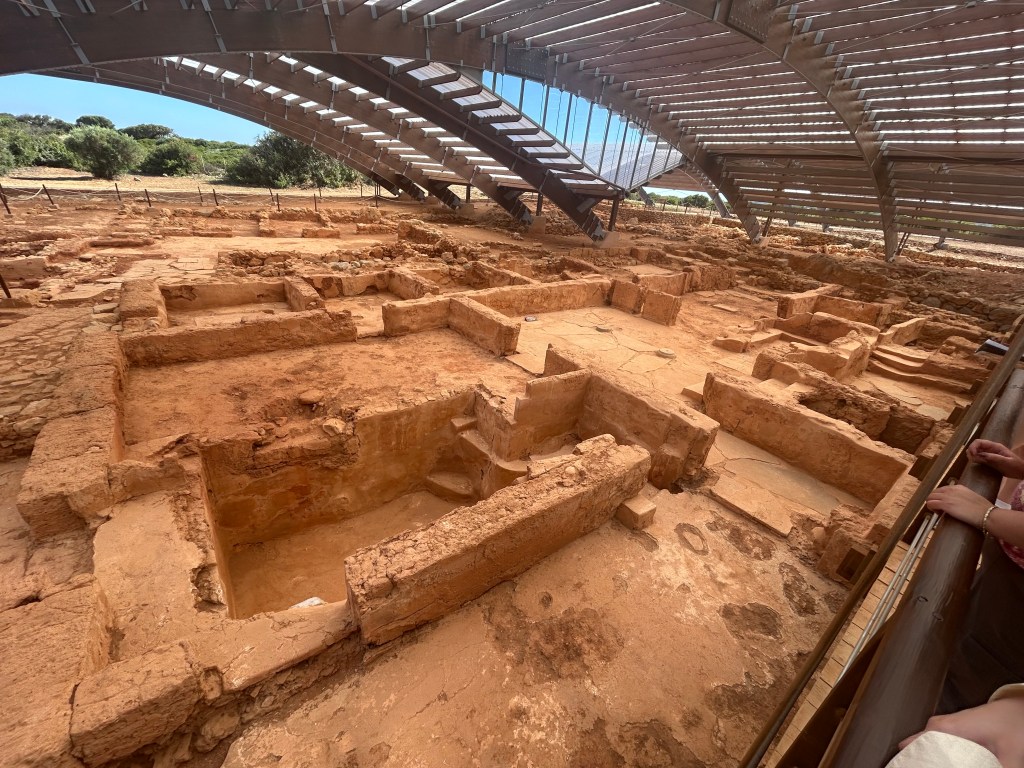
~View of lustral basin and light well in Quartier Mu
After viewing Quartier Mu, we visited the ruins of the palace at Malia. The palace like Quartier Mu is another example of an elite structure with two large courtyards, storage magazines, granaries, and religious area within. The palace is one of the oldest but was destroyed in an earthquake, rebuilt later and then destroyed again by fire. An interesting artifact found at the site and other sites is a kernos, a circular stone with small holes in a ring on the edge of the circle that was used to place small seeds or other crops as offerings.
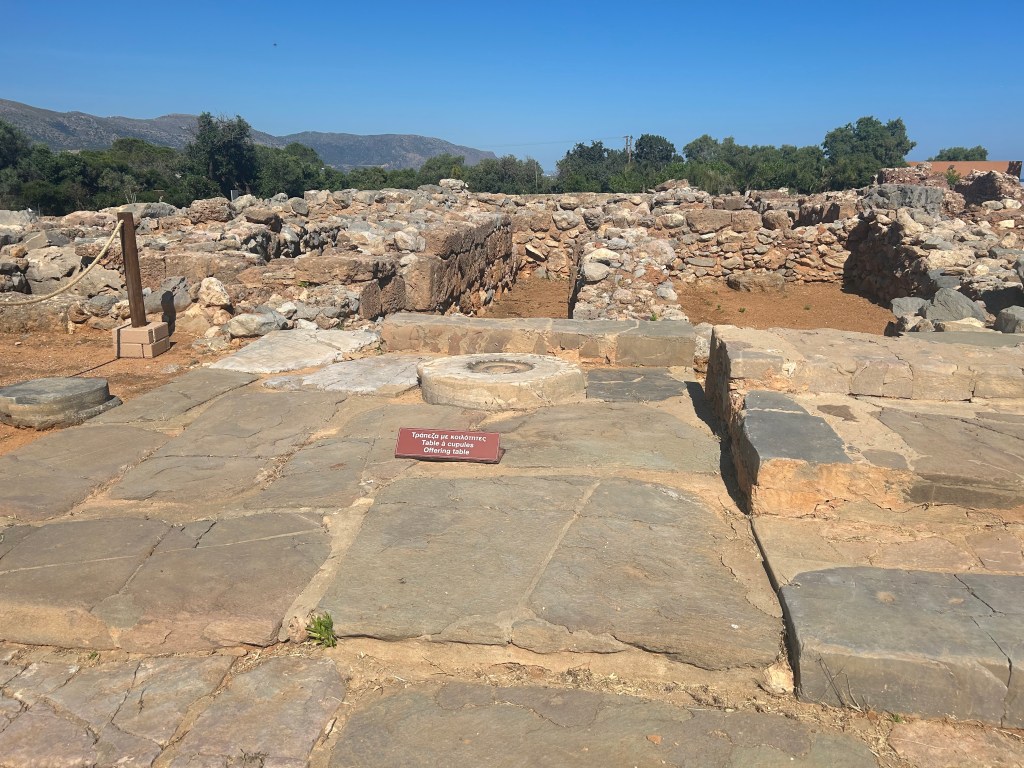
~Kernos Stone at Malia
After visiting the elite sites of the Malia palace and Quartier Mu, the next site was Gournia. Gournia compared to Malia is more focused on the everyday life of the Minoans. Originally excavated by Harriet Boyd Hawes, a trailblazer for women in archaeology as she was the first woman to lead an archeological dig. Luckily, when we visited, we had someone who knew the site pretty well and was able to give a comprehensive view of the chronology of the settlement. At the site there were some very interesting artifacts, a kernos, pottery sherds, and a mason’s mark.
The kernos was interesting as mentioned before at Malia it is believed to be a stone with ritualistic purposes but at Gournia, it appears to have changed in use over time and was being used as a game of sorts. The pottery sherds were all around the site but there were many instances of them being collected and put on a stone. Dr. Buell said it was tourists putting them together thinking they were valuable. The mason’s mark of a double axe was engraved onto a piece of stone near the palatial structure. This mark was also found at Knossos which Arthur Evans linked to the Minotaur. That is not the case, but instead a mason’s mark to show which blocks of stone were cut by who.
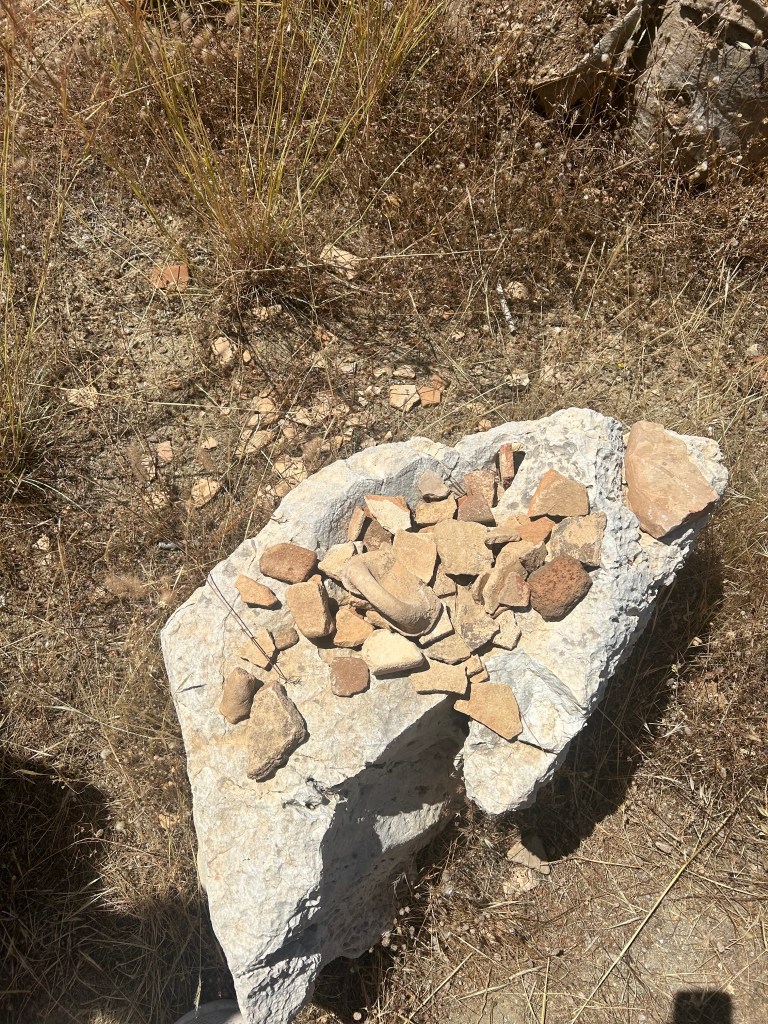
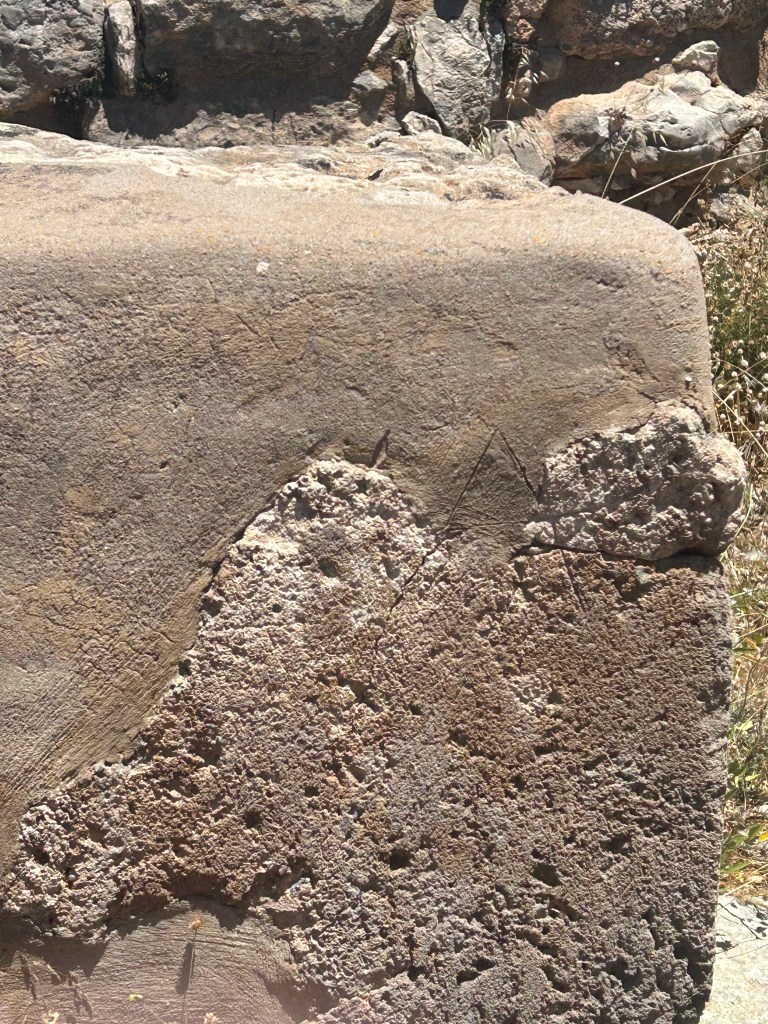
~Pottery sherds (above) and double axe mason’s mark (below)
Seeing both the elite sites of Malia and the sites of everyday people at Gournia gives a more complete picture of Minoan life. Seeing the same artifact, the kernos, being used as a religious object at one site and as an object of games shows how things change over time and purposes do not remain static.
~Kyle McGilton


Leave a Reply