
June 2nd, 2026
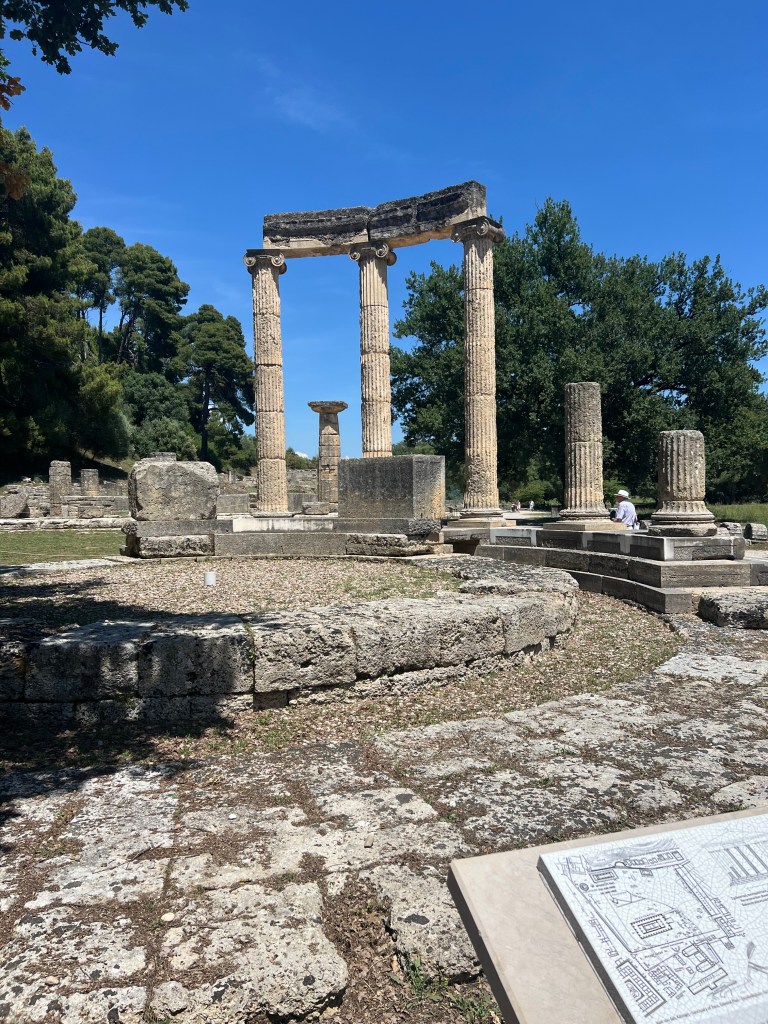
Today, as part of our summer field course, we visited the ancient site of Olympia. We saw the temple of Hera, the temple of Zeus, the Philippeion, the original track for the Olympic races (which we ran on) and the museum.
The monument that struck me the most was the Philippeion. Its construction started in 338 BCE by Philip II, and it was then completed after his death, by his son Alexander the Great. The year 338 BCE is especially important, because it was the same year that the battle of Chaironeia occurred. The rivals in this battle were Thebes, Athens, and Corinth, against the Macedonians. When the Macedonians won, Philip II became the ruler of Greece. He then thought it was fitting to add a monument dedication to him in Olympia, to mark his victory against the Greeks.
The architecture of the building itself was very beautiful in my opinion, as it was a tholos style of temple, meaning it was round, and it had an ionic colonnade on the outside. It also had a row of nine Corinthian style semi-columns on the inside, but they not longer exist. The roof was made of clay-tiles and ended with a bronze poppy.
Philip also added five chryselephantine statues in his monument, which elevated him to the status of a god. These statues, built by the famous sculptor Leochares, were reserved for deities, as the ivory and gold made them look ethereal. For example, there was a chryselephantine statue in the temple of Zeus on the same site. The act of adding the statues to his monument left the message that the Macedonians would be there for a while. It sent the message of a growing dynasty.
What marked me about this monument was how egotistical it was of Philip to add a monument to himself in a site used for athletic victories. It was very boastful and self-absorbed, and the thought that came to mind when looking at this site and learning about these facts was that it surely would not have been a very popular monument for the Athenians and Thebians, among others. The whole idea of adding a personal monument in a sanctuary is inappropriate, considering the temples built there were for praying to deities, not for personal gain or advertisement.
While the concept of building a temple for Philip was egoistical and inappropriate, the spirit of agonistic competition was still there. It fit well to be put on the site of Olympia, simply because it was, as a base, a tribune to victory, same as the other monuments there.
~Annabelle Charpentier-Patry


Leave a Reply