
Today was our second day in Athens. We were given a beautifully done lecture today by Livia on the Library of Hadrian, a man who loved Greek culture so extensively that he sought to beautify Athens, leaving a lasting Roman footprint on the city. Notably, he was also the first Roman leader to grow a beard, a fashion that later emperors copied. The library was a monumental complex, featuring a large courtyard surrounded by rooms, with a striking monumental facade. While it functioned as a library, it also served cultural purposes, including lecture halls.
The Agora was the center of athletic, artistic, business, social, spiritual, and political life. The verb agorazein meant to gather for political activity, worship, athletics, and to hear the news . Any Greek city-state defines itself by having an agora. While there must have been an earlier one, its location is debated; this is the Classical Agora. The stoa buildings (like the Stoa of Attalos, which houses the museum) made significant political statements.
We dove headfirst into the ancient world at the National Archaeological Museum with our wonderful guide Heinrich! After a morning navigating the city’s lively streets, we spent hours wandering through halls filled with bronze gods, Cycladic figurines, and Mycenaean gold. The sheer volume is overwhelming: every case holds something that would be the crown jewel of any other museum. I found myself lingering in the section on Attic funerary monuments. These marble stelai and lekythoi ended up being the highlight of my day. Ancient Greek grave stele are upright stone slabs carved with reliefs or inscribed with poetry that served as cemetery markers or memorials. These monuments featured family scenes, banquets or intimate portraits of the deceased. As our tour guide pointed out one of his favorites was of the funerary stela of Demokleides.
The grave stone that caught my attention was a Classical grave stele showing the handshake between a seated figure and a standing one. No dramatic grief. No wailing. Just two people clasping hands, one departing and one remaining. What struck me wasn’t just the artistry, though the carving of the drapery is breathtaking. It was the historical implications.
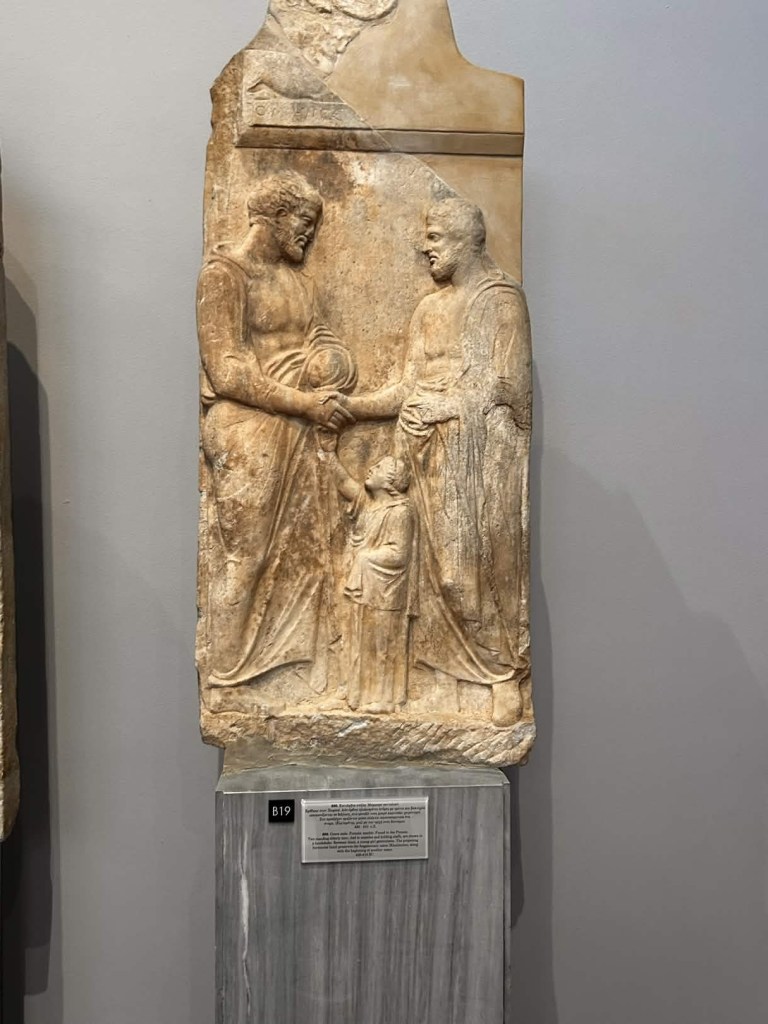
These monuments reappeared in Athens during the first decade of the Peloponnesian War (431–404 BC), after a long hiatus imposed by a prohibitive law under Kleisthenes. What changed? The plague. Breaking out at the war’s start, it ravaged Athens until 425 BC, killing Perikles himself. Full of fear and sorrow, the Athenians cremated their dead in masses to limit the disease’s spread. That political, economic, and moral upheaval strengthened conservative powers, who succeeded in restoring the ancient custom of private memorials. What moved me most was how the Athenians chose to remember. The imagery is striking for what it doesn’t show. No corpses, no grieving skeletons, no underworld monsters. Instead, idealized figures with controlled emotions. The dead shake hands with the living. The message is not loss but continuity, a family bond that death cannot take away.
I stood there thinking about the plague years. Athenians watching neighbors die. Mass cremations. Then, out of that horror, a return to carving stone handshakes. That act, rebuilding private remembrance after catastrophe, feels deeply human.
~Isabella Michel


Leave a Reply