
By Tess Harty
Our first stop this morning was in the town of Spili, where we enjoyed a coffee break and explored the town’s hilly, winding streets. We had the chance to drink clean, fresh mountain water from Spili’s Venetian-built public fountain, which has been in use since the sixteenth century.
After a brief stop at our hotel in Rethymno, which has a gorgeous view overlooking a harbour on the Sea of Crete, we embarked on a walking tour. The first place we visited was the Archaeological Museum of Rethymno. There, we had the opportunity to see Neolithic and Mesolithic stone tools found south of the city. Importantly, the presence of tools belonging to the Achulean stone tool industry, whose closest comparanda are in North Africa, indicate that groups of Homo erectus were visiting Crete about 300,000 years ago. This discovery demonstrates human, or hominin, presence on Crete much earlier than previously thought.
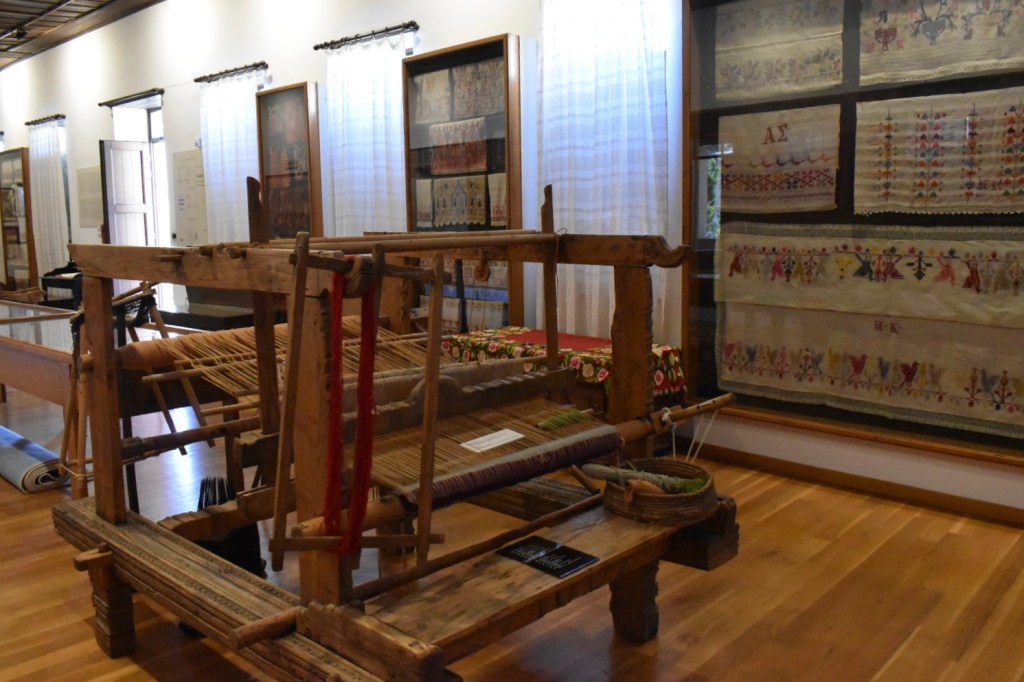
Next, we visited the Historical Folk Art Museum of Rethymno. Inside we found objects from modern Greek history, including weapons, coins, documents, and textiles. A large section of the museum is dedicated to traditional textile art; many of these items, which have geometric and figural designs, show the interplay between artistic representation and narrative. References to historical events in some of these examples of needlework provide an interesting perspective on peoples’ interactions with the world around them. In addition to showing finished products, the museum showcases the tools used to create them, thereby exhibiting the whole production process.
In the afternoon, we toured the Venetian fortification (fortezza) of Rethymno. The fortress offers commanding views over the city, which in the past made it an important strategic and defensive construction. After a quick stop to look at the contemporary art exhibition housed in one of the fortress’ buildings, we climbed to the top of the fortified hill. The 360° views of both land and sea not only made for great photographic opportunities but also made it easy to visualize how, throughout history, Crete was an important location within a maritime communication network.
I was impressed today by the intricacy of traditional needlework from Crete. In terms of production, design, and technique, these woven and embroidered textiles represent the maintenance of local Cretan craft traditions. In Spili, I spoke with a shopkeeper, Daniela, who explained the process behind the local method of hand embroidery. Women pick out the threads in a piece of textile, called Itami, to form geometric patterns. Because the threads have been pulled, the square gaps in the textile’s crosshatch weaving become larger, making it easier to insert thick embroidery thread. Then, brightly coloured thread is woven into these square gaps in the fabric’s weaving. The shopkeeper noted that one piece takes about a year to make, given that there are only two women in the area who still practice this type of embroidery and that embroidery is picked up sporadically, whenever there is time. The designs are unique, dependent on the size of the textile, the colours available, and the pattern that each artisan creates. Alongside embroidery, lace-making (referred to as tatting) and textile weaving are also practiced locally. In addition to being beautiful, these handmade items are also practical. Their function as tablecloths, napkins, fabric for clothing, etc. lends itself to daily use. Nevertheless, the decorative quality of these items cannot be understated. The intricacy of the weaving, as well as the significant investment of time that is required to produce a handmade item (both in the planning and execution stages), points to a high level of craftsmanship.

Daniela also noted that a local folk museum was set up by the granddaughters of local weavers to showcase their grandmothers’ handiwork. Unfortunately, there was not enough time during our stop at Spili to visit this museum. Nevertheless, the examples of embroidery that I saw at the shop provided an idea of the kinds of designs being exhibited. Beside the embroidered textiles for sale was a book of photography that showcased other handmade needlework designs. The establishment of a museum dedicated to the artistic aspect local textile production emphasizes the decorative importance of these pieces, commemorating the creativity inherent in the local textile industry.
 Concordia CMLL Study Tour
Leave a comment