
By Max F. Plaugher
While today was one of the shortest days we have had, it was also one of the strangest. We were only able to meet two of the four plans we had for the day, the Archaeological Museum of Messara, and a quick tour of the Roman tombs of Matala. Our first interrupted plan occurred with us leaving Heraklion, only to learn that we would be unable to make it to our first stop, the Minoan Villa in Vathypetro, as it had been closed. Our second interrupted plan occurred when we had arrived in Vori to see the Museum of Cretan Ethnology, only to realized it was locked with no one inside (despite the sign saying it should be open), and then when someone who worked for the museum had apparently arrived, it was a less than welcoming affair that resulted in our swift leaving of the town.
However despite all of this, we were still able to learn much from the locations we were actually able to see, such as with our first stop in the Archaeological Museum of Messara, where there were many artifacts present that we were able to explore. From pithoi from Gortyn in the Neopalatial period, to a 10th century AD brass processional cross from the Church of St. Titus, there was a wide range of items to investigate.
My particular favorite was this 3rd century BC candelabra with seven lamps that was discovered in a sanctuary in Gortyn. It caught my attention due to the fact that, throughout this tour, we have seen a vast quantity and wide variety of clay lamps, from Mycenaean to Roman, but I had yet to come across something that looks like this. Prior, I had seen lamps that would give off multiple sources of light, as they would have multiple spouts to expel the flame, but this appeared to be a series of individual single-flame lamps that had been joined together to form a candelabra. I found the ingenuity in its creation fascinating, as well as learning how its existence is an indicator that those in the past that had procured this item were likely using it for nocturnal rituals. I also learned, funnily enough, that a candelabra does not need to have candles.
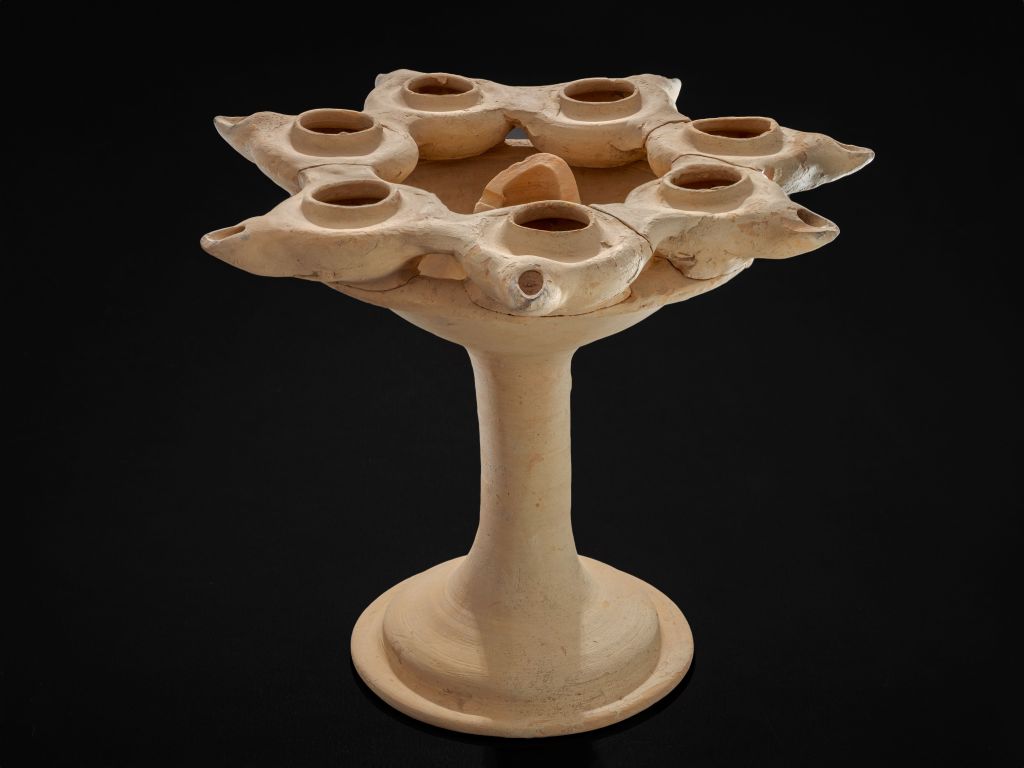
Image of the candelabra from the Archaeological Museum of Messara website.
My other favorite experience from this day was learning of the arcosoli that dot the bluffs of Matala. I initially found it interesting due to the fact that these tombs show a clear sign of Roman presence in the area, as well as indicating how in the past, Matala would have served as a seaport for the city of Gortyn, as Gortyn was the provincial capital of Crete during Roman occupation, and would require sea access. However, what also took hold of my interest, was how these tombs served as hideouts for hippies during the counter-culture movement, and was even occupied by the musician Joni Mitchell for a time.

Photograph I took of the tombs while at the beach in Matala.
 Concordia CMLL Study Tour
Leave a comment