
By Ashley-Marie Maxwell
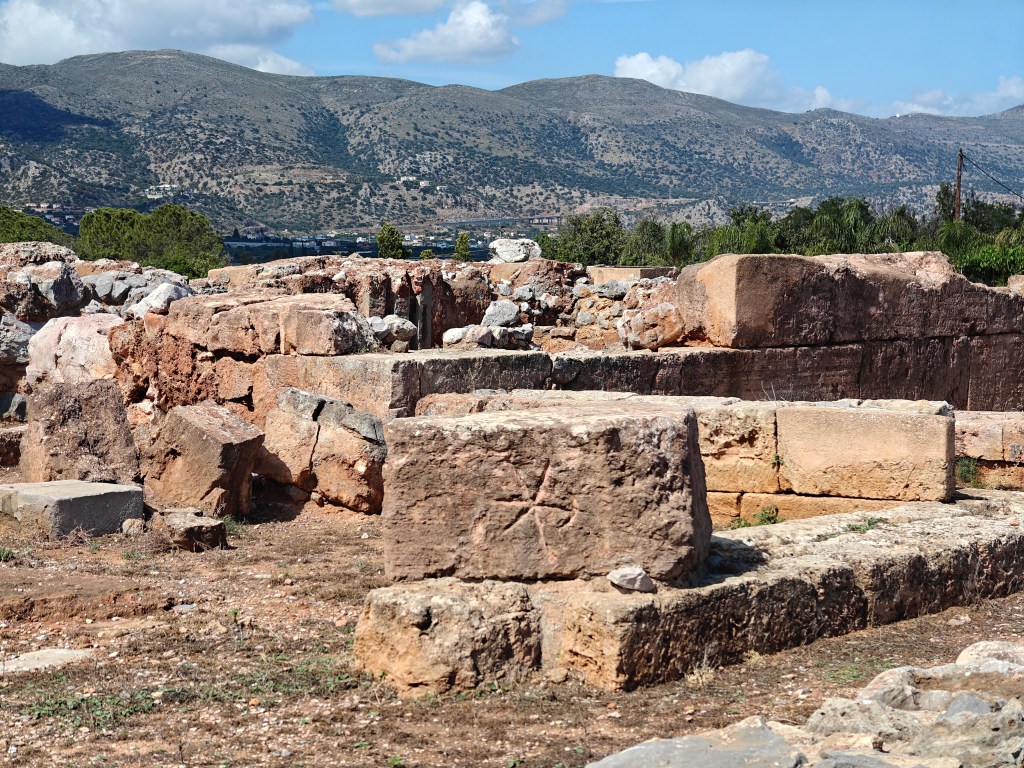
We started our day by visiting the palace at Malia, a complex structure comparable to Knossos in terms of its long, sustained development throughout the Bronze Age. One of the areas that stands out at Malia is Quartier Mu, a Protopalatial workshop and living area just outside the palace. Linear A documents found at the site reveal Quartier Mu’s involvement in the production of metal vessels, as well as the use of ashlar masonry in the construction of the town. This is of particular interest when contextualizing Malia’s role within the palatial complexes around Crete. In this sense, Quartier Mu’s particularities anticipate the later Neopalatial traditions observed at Knossos.
Among the workshops at Quartier Mu, we find evidence at Building A for production of pottery appliqués, metalworking at a dedicated foundry, and seal stone carving at a lapidary. It would seem that these goods were produced by and for the inhabitants of Quartier Mu, which sets this area apart from the palace and its administrative function. In fact, we may even speculate that Quartier Mu functioned as its own centre of production and elite dwelling area independently from the palace—an unusual feature seeing as how palaces are typically the primary centres of activity.
The palace at Malia reached its peak in population during the Protopalatial and then saw a decline and eventually suffered a total destruction following an earthquake. Meanwhile, the slow eastward expansion of Knossian power may have served Malia in its rebuilding during LM IA, as evidenced by the presence of identical mason’s marks found at both palaces.
It is at Malia where the famous Bee Pendant—currently held at the Heraklion Archaeological Museum—was found in the Chryssolakkos, the “gold pit,” a Bronze Age house tomb. The high-quality item, along with other objects of a similar nature, indicates that the community must have been quite wealthy and primarily formed of elite members of society to afford such luxuries.
Our second stop of the day was the East Cretan palace at Gournia, overlooking the Bay of Mirabello. The site was first excavated by Harriet Boyd Hawes in 1901 and has since been the subject of arduous conservation and active research work. While Hawes was especially concerned with Neopalatial Gournia, recent work in the last decade has revealed earlier Protopalatial structures which has required a thorough re-examination of the site via new coastal surveys and mapping of the area.
The Protopalatial stratigraphic level shows a nucleation and centralized community, which led to the construction of the palace as a consolidated place of power. The peak of its prosperity is dated to be during LM IA, but the subsequent LM IB saw a period of trouble and destruction at the hands of humans. After a destruction in LM IA, the palace was partially rebuilt with new materials such as ashlar blocks as seen at other palaces.
One of the features of an even later rebuilding (LM III) is the construction of a Minoan corridor house that pre-dates extant ones at Mycenae, Tiryns, and Pylos. Its only contemporary example is at Menelaion, which shows a cultural exchange between Crete and the Mainland. This connection is already known through observations of Mycenaean culture and its reliance of Minoan motifs and styles, but it is interesting to see the reverse happening in this case, in which the Minoans at Gournia took inspiration from the Mainland to rebuild their palatial complex and town.
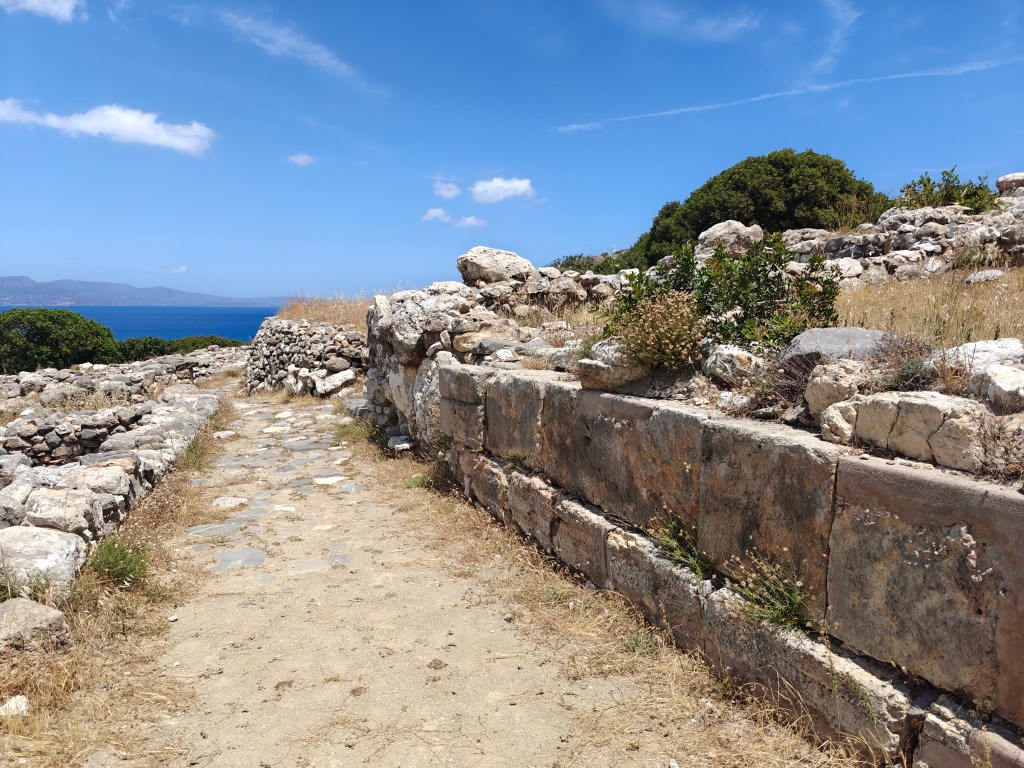
Overall, Malia and Gournia show different modes of life for Minoans based on location and topography. Quartier Mu’s emphasis on the production of elite goods highlights its self-sufficiency and wealth that rivaled with the palace itself. While Gournia may not have known the same kind of lifestyle, its direct connection to the Mainland shows that the region was not isolated from other communities. Cultural exchanges took place between the different regions of Greece, thereby dispelling the idea that these early communities were insular and technologically underdeveloped. The palaces on Crete teach us that these societies were highly complex and, although they were victims of manmade and natural destructions, their resilience and desire to endure through time encouraged them to rebuild and to improve their towns economically, architecturally, and culturally until the collapse of the Bronze Age.
 Concordia CMLL Study Tour
Leave a comment