
By Katerina Douzepis
Picture this: It is a warm summer’s day, a calm wind tours the mountainous landscape and brushes past as you sit atop a tripod in the Temple of Apollo. You utter a simple yes or no, possibly a vague “perhaps” to the humble man in front of you who has been waiting patiently in line for your response. You take another laurel leaf in hand and chew on the one already in your mouth as the next inquirer steps before you. It has been a long day as the Pythia of Apollo and there are many who seek your audience today at the Panhellenic sanctuary of Delphi…
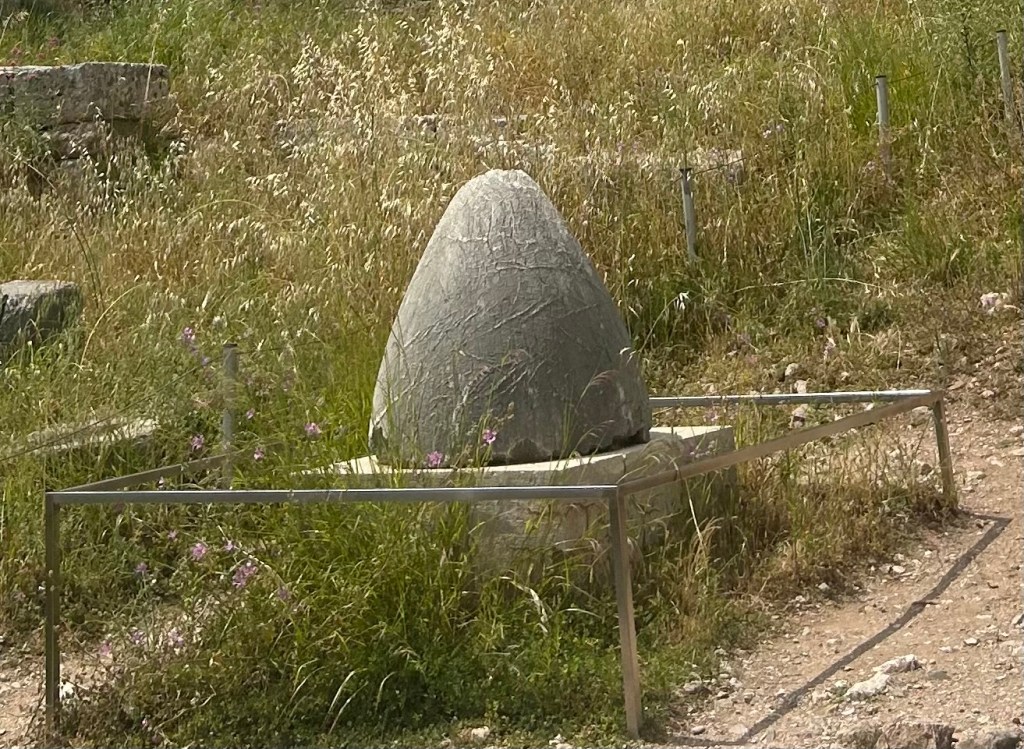
As you, dear reader, might have guessed, today we walked the sacred path through the Sanctuary of Apollo at Delphi, one of the UNESCO world heritage sites, found on the slopes of Mt. Parnassus. As myth would have it, this location in particular was chosen after two eagles sent out by Zeus from opposite ends, flew past each other and dropped a stone. This would then become known as the center of the world or Omphalos (navel) of the earth. The precise location where the stone was believed to have been dropped has been denoted by a simple cone shaped stone sitting outside on the path in place of the Hellenistic copy kept in the nearby Museum.
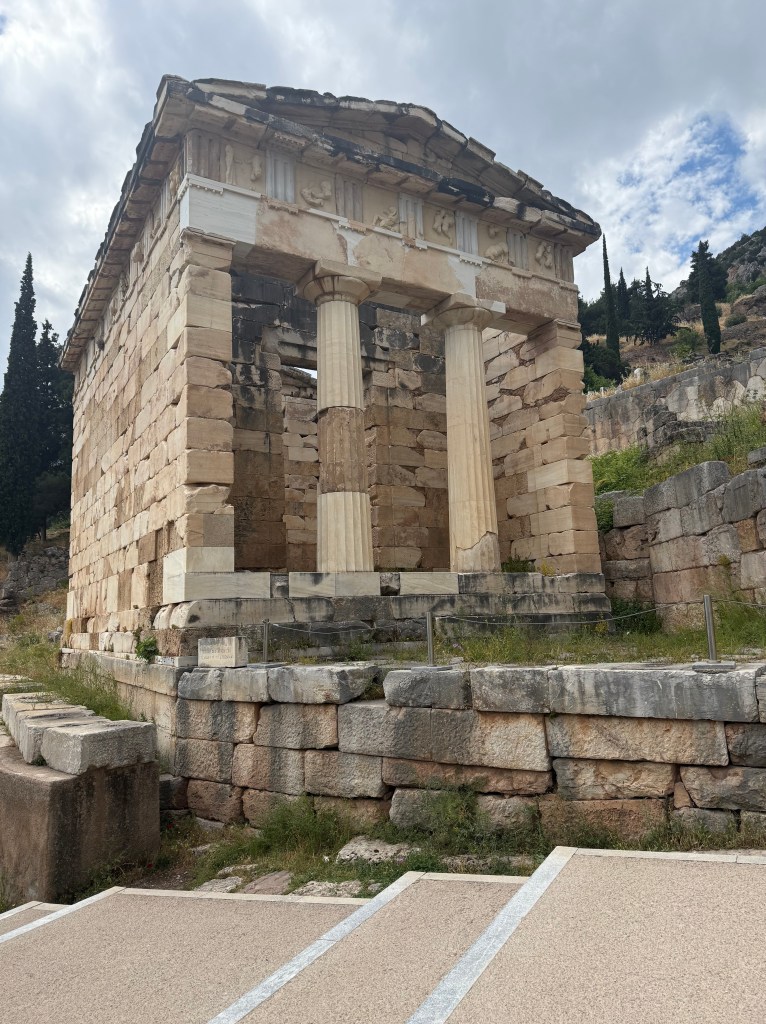
Continuing onward towards the Athenian Treasury, we had a lovely little presentation by one of our classmates about the treasury’s timeline, uses, and cultural significance. Having been built in the 5th c. BCE, this Parian marble structure would have housed, as the name would suggest, the many votive offerings and spoils of the Athenians while also serving as a prominent marker for Athenian identity. Unlike the Athenian Treasury, the one by the Siphnians just below would have been designed according to the ionic order, with an uninterrupted frieze (the first of its kind), and two karyatid support columns in the front— an impressive structure in itself, due to its decorative nature and painted quality.

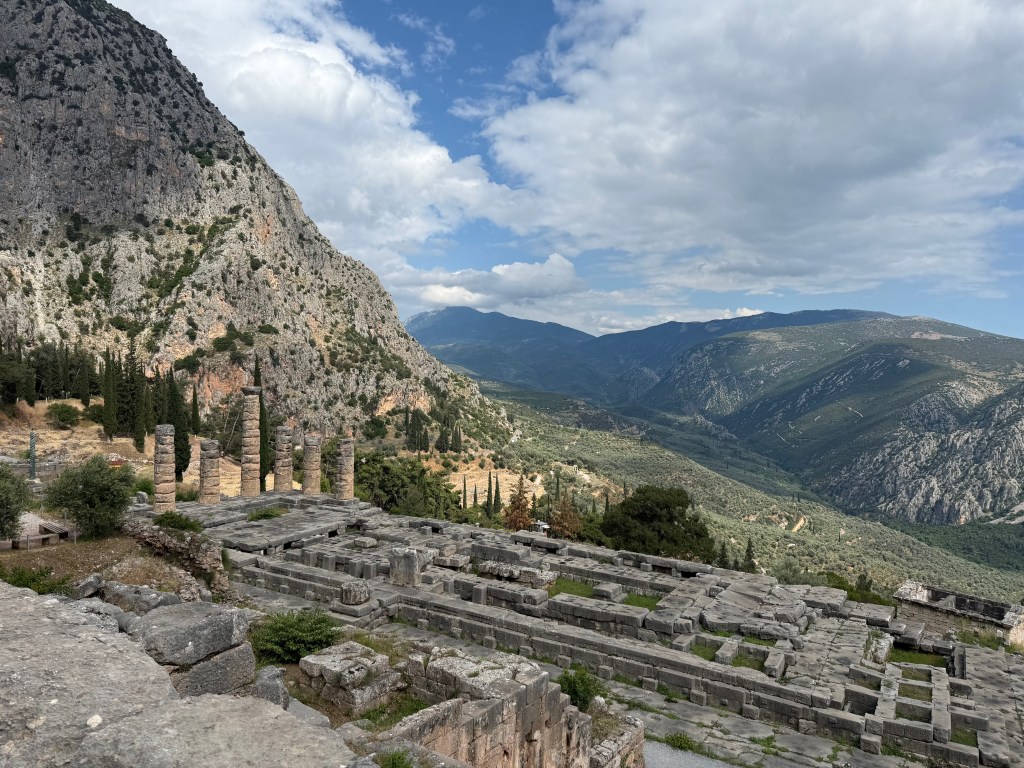
Passing the famed Serpent Column(s), we came upon the star of the Sanctuary of Delphi, having been rebuilt/renovated three times over the course of the 7th – 4th c. BCE, this was the Temple of Apollo. After another presentation, we learned about its grandeur— a peristyle of the Doric order housing an inner cella, with marble pediments depicting Apollo and the Muses, and Dionysus and the Maenads. Other than being the main place of operation for the Oracle/Pythia of Apollo during the summer months, the Sanctuary as a whole, elevated by the temple, served as a common point of interest for many of the sponsoring city states, thus adding to its significance. In line with this, among one of the most powerful women in the ancient Greek world, the Oracle would have been chosen from the priestesses of Apollo to act as his conduit, answering the many inquiries of those rallying to pose their questions. It is thought that one of the last oracular statements in he 4th c. CE revolved around the imminent rise and/or conversion to Christianity (or something of the sort).
Following this, we ventured to the museum where we were able to observe many of the artefacts mentioned during our walk, such as the metopes of the Athenian Treasury, the friezes of the Siphnian Treasury, the pediments of the Temple of Apollo, and many more.
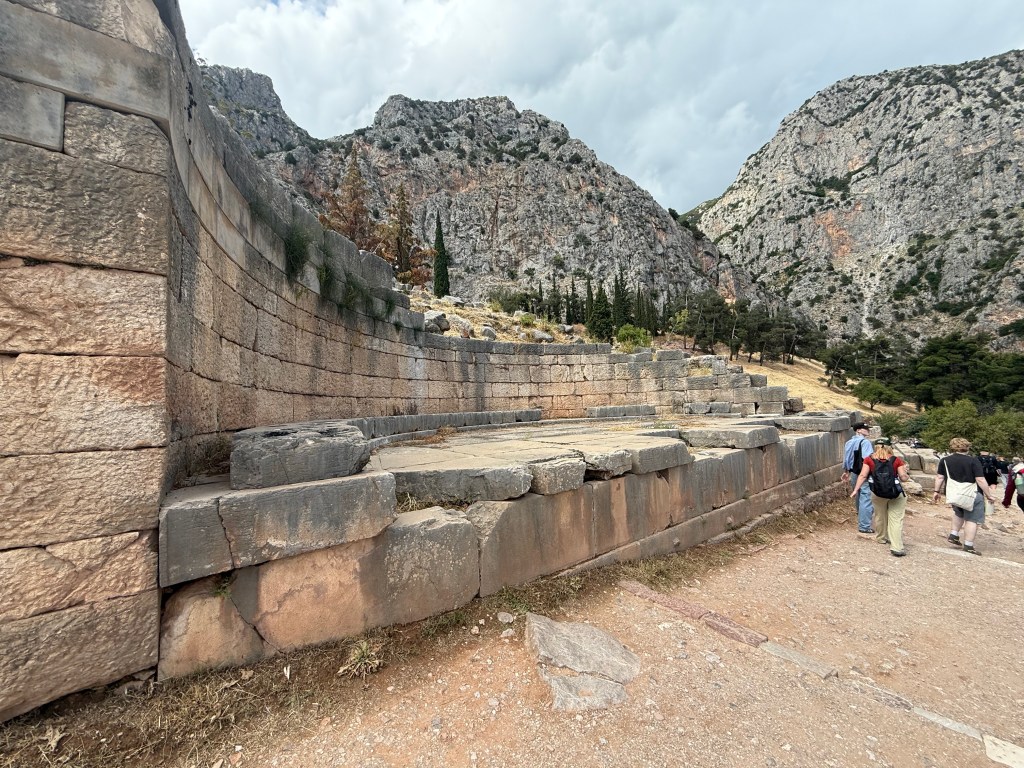
Interestingly enough, what stuck with me like a piece of gum at the bottom of a shoe, perhaps due to its humorous nature, were the Exedra of the Kings of Argos and the Exedra of The Epigones by the Argives in comparison to the Lacedaemonian Trophy by the Spartans. Seeing as how it was common to make a donation in the form of a monument as a gift to the gods, both the Spartans and Argives left their mark on the sacred land of the Delphic sanctuary. The funny bit comes in when taking into account the historical feud between Argos and Sparta concerning dominance over the Peloponnese and the subtle (or not so) pettiness lurking beneath their actions when it comes to spiting one another. In this case, while the Spartans dedicated one monument to Delphi, the Argives built two. One references the previous kings of Argos and the other references its legendary Seven Heroes. Both would have presented statues of their representative figures.

In all, the Sanctuary of Delphi stood as a spiritual and cultural epicenter of the ancient Greek world, revered not only for its mythical origins as the center of the earth, but also for its role as one of the great Panhellenic sanctuaries. From the awe-inspiring Temple of Apollo—home to the famed Oracle, to the treasuries and monuments left by rival city-states, Delphi reflected both divine reverence and political rivalry. Its structures and artefacts, rich in artistic and historical significance, continue to speak to the unity and competition that shaped the classical world. Walking through Delphi is not just a journey through ruins, but a vivid step into the heart of ancient identity and belief.
 Concordia CMLL Study Tour
Leave a comment