
By Anna Lindsay
I must admit, when my roommate and I entered our hotel room in Pylos just yesterday, we were both slightly bummed that we would only be staying a single night. That being said, we set our alarms for the next morning, woke up in a timely manner, and began the roughly two-hour bus ride to the beautiful archeological site in Messene, where we were all given the chance to free roam the site for about two hours, and take in all of the architecture of the settlement dating back to the Hellenistic period, with site activity dating back all the way to the Bronze Age. The site itself is essentially a picturesque nature walk, complete with ancient ruins of an agora, theatre, stadium, and a sanctuary to Asklepios, the god of medicine, among other various archeological and natural curiosities.
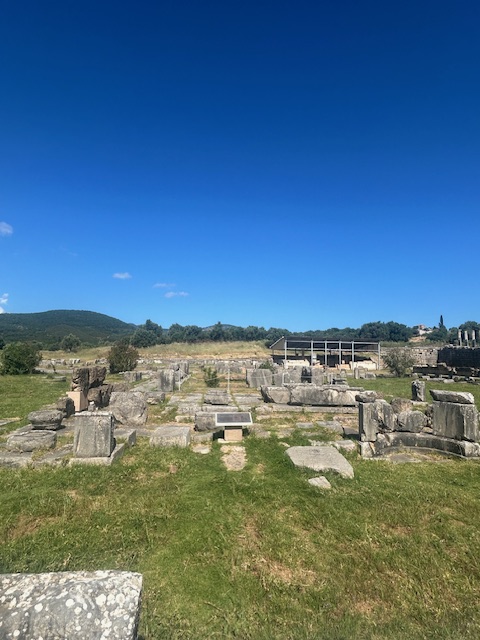
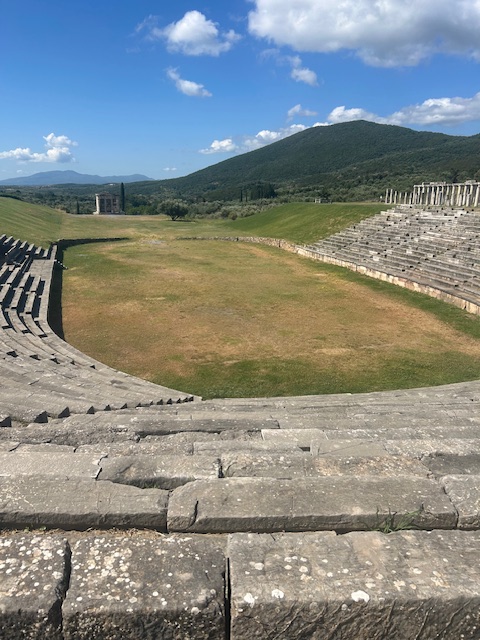
After another two-hour bus ride, fitful nap, and brief pit stop for a lunch-esque meal, we arrived in the ancient site of Olympia, the home of the original Olympic games, where we met up with Angelos Gkotsinas, an archaeologist currently working on the site at the workshop of Pheidias. We were taken around the site by Angelos, where we were able to see the Temple of Zeus, some of the original gymnasium where athletes would train, an ancient hotel, and even a running track (I was goaded into joining the class track competition, and yes, I did walk half of it).
A particular piece that struck me was the West Pediment of the Temple of Zeus, housed in the adjoining Archeological Museum of Olympia, depicting a battle between the centaurs and the Lapiths, including the attempted rape of the Lapith women. The pediment displays a dynamic snapshot of the attack, featuring one woman pulling at the beard of her assailant, another woman attempting to pull the groping hand off of her chest and waist, the Lapith men fighting against the centaurs, and at the very center the god Apollo, standing calmly and watching the violence without comment. The piece is a prime example of the Severe Style of artwork found in the first half of the 5th century BCE, with an emphasis being placed on the movement of the bodies depicted in the piece, as opposed to the more rigid figures of the Archaic period. The experience of looking upon the collection of sculptures is incredibly visceral, especially as a woman, witnessing the indents the centaurs’ fingers leave in the skin of their victims, or the image of a disembodied hand forever clutching a woman’s hair, or even the pained expression on one of the centaurs as another disembodied hand rips at his facial hair. The piece is an encapsulation of the physical emotions of sexual violence, even if these emotions are not expressed on the faces of the women (a point within Greek art of the separation of man and beast), and its ability to elicit these acute sensations within their viewer.
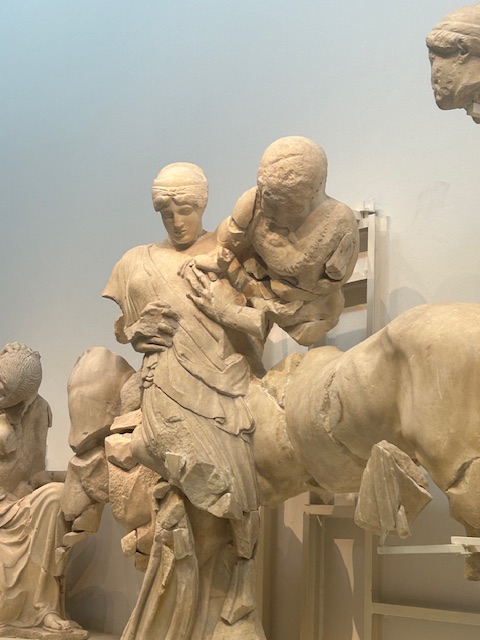
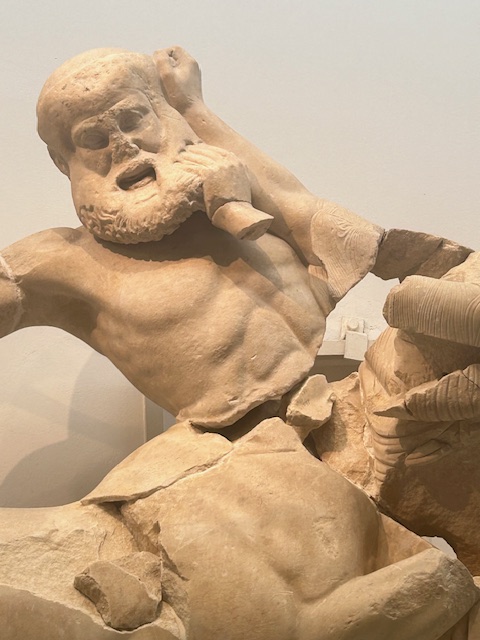
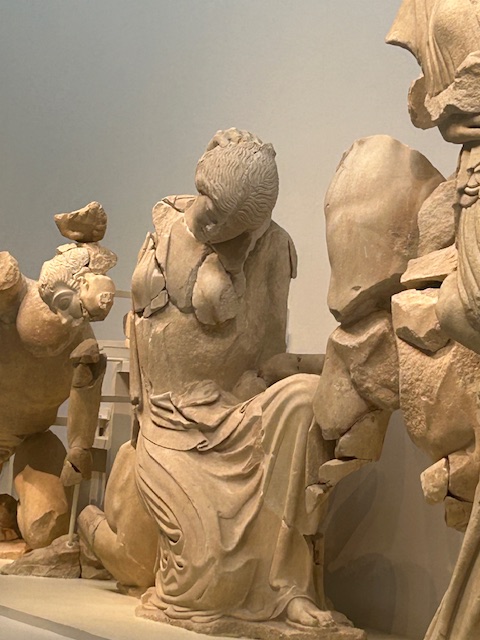
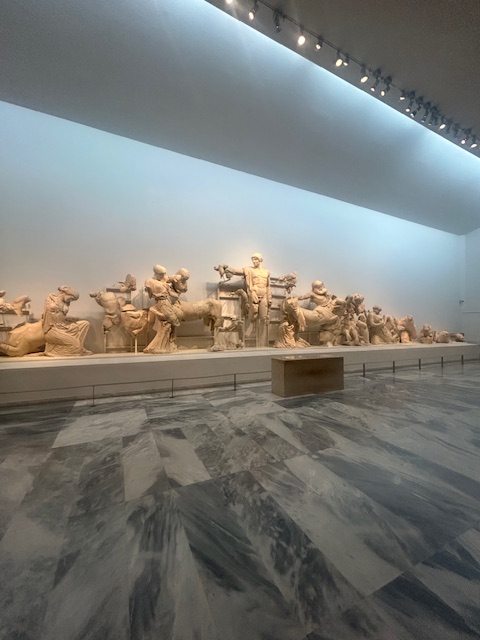
Full image of the West Pediment of the Temple of Zeus, first half of the 5th century BCE (Archaeological Museum of Olympia)
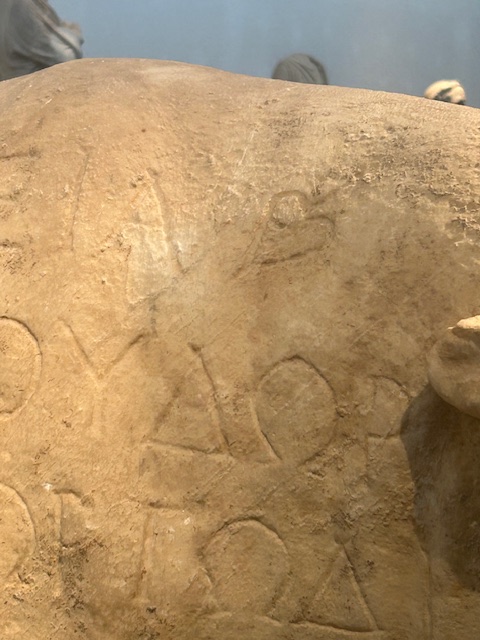
I hate to finish on a down note, so as a small post-script, we also viewed a statue of a bull, displaying a votive inscription from the sculptor Herodes Atticus in the name of his wife Regilla, reading “Regilla priestess of Demeter offers the water and appendices to Zeus” complete with a small carved heart, a nice reminder of the ways in which not just violence, but love can lead us to create art.
 Concordia CMLL Study Tour
Leave a comment