
By Juliana Vergara Nunez
What a day!
If anyone had not caught some sun yet during our time in Greece, today definitely took care of that… We spent nearly the entire day outdoors, soaking in the sunshine and exploring some of the most remarkable archaeological sites of the Peloponnese region.
Our first stop was Tiryns, where we got to see the impressive remains of a fortified Cyclopean-style Mycenaean palace, those stones are huge. From there, we headed about 20 km northeast to Mycenae. We explored the palace ruins, admired the famous tholos tombs, and visited Grave Circles A and B. After a much-needed lunch break, we made our way south to Lerna (about 24 km from Mycenae). There, our classmate Jeremy delivered a fantastic presentation on the House of Tiles, opening discussion for what we thought the purpose of this building was. Finally, our day concluded with a visit to the Zotos Brothers Biofarm, where we baked cookies, ate delicious Tiganites (Greek pancakes), pressed fresh orange juice, and even had a few Greek dance lessons. We also had the opportunity to walk around the farm and learn about the production of their products. They cultivate olives, oranges, mandarins, berries, and lemons. Learning about their organic farming methods and the sampling of their products was a perfect, wholesome end to the day.
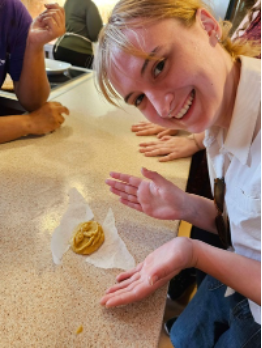
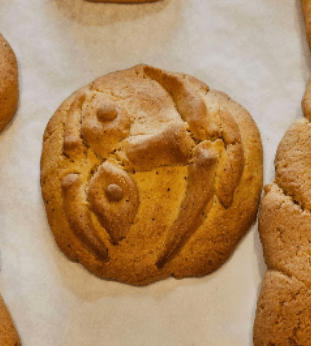
Isabelle and her baking creation, an orange cookie replica of the Agamemnon Mask (Zotos Brothers Biofarm)
Two things stood out the most to me today (besides the exquisite taste of the Taganites with cheese) both found at the museum in Mycenae. While examining some votives from the Shrine of the West House in Mycenae, dating from the late 6th to early 5th century BCE, I came across a couple of pieces that were new to me.
The first was classified simply as “animal.” It had a streamlined, rounded body, short front flippers, a tail at the back, and a small, rounded, slightly upturned nose. Sounds familiar? To my eyes (and the eyes of Dr. Buell and some of my classmates) this resembled a seal. Something none of us had ever seen before as votive. While I couldn’t find any specific information online about seals as votives and their significance, I did learn that monk seals are sometimes found around the Argolic Gulf, visible from Nafplion. This suggests that people from Mycenae could have actually seen monk seals in their region, eventually creating clay votives of them for ritualistic purposes.

Animal figurine (potential seal), Archaic period, end of 6th, beginning of 5h century BCE, (Archaeological Museum of Mycenae)
The second thing that caught my attention was also classified as a votive called “anthropomorphic figurines” (anthropomorphic meaning the attribution of human characteristics). These figurines featured articulated limbs, allowing them to be moved, much like marionettes or traditional dolls such as the Karagiozis, mobile shadow puppets used in Greece since at least the Ottoman Empire. How cool is that? Ancient figurines you could actually pose as if they were alive. Professor Buell, some of my classmates, and myself, discussed whether these votives could have served as children’s toys as well, and we all agreed that it could likely be the case too. However, some questions remain: why were these objects placed in the shrine as votives? What was their purpose? And when did this civilization possibly see a seal? These are questions that may never be answered, but they’re certainly fun to hypothesize about.
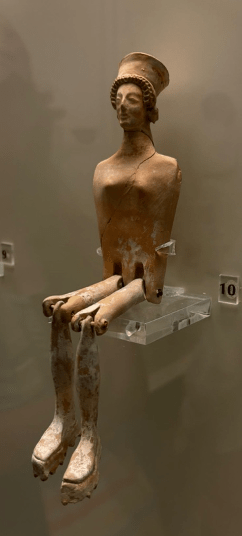

Anthropomorphic figurines. Archaic period, end of 6th, beginning of 5h century BCE (Archaeological Museum of Mycenae)
These two votives, which were particularly new to me, reminded me once again of how limited our knowledge of the past, especially the Early Archaic period and earlier, truly is. It also sparked an idea to possibly write a paper on how Greek fauna is represented through votives, exploring their meanings, types, materials, and potential ritualistic uses. Moreover, while the origins of Karagiozis are not directly related to these Mycenaean articulated figurines, it is still fascinating to compare them and explore their similarities. Such comparisons may offer a bridge of interest, highlighting what early and modern Greeks might have considered as forms of entertainment or tools for education/spiritual connection. Overall, today was an enriching experience, just like all the previous days. Stay tuned for more insights from my peers in their upcoming blog posts.
 Concordia CMLL Study Tour
Leave a comment