We Are All Connected – A Day at the National Archaeological Museum
By Arlene Padda
Today, we began our day at the National Archaeological Museum with our guide Heinrich leading the way. The museum in Athens houses some of the most important artifacts from a vast variety of archaeological locations across the Greek mainland and islands. Unlike the Acropolis Museums we visited on the 6th, this museum is not site based. It is an amalgamation of artifacts all over Greece organized either chronologically or thematically.
National Museum of Archaeology, Athens
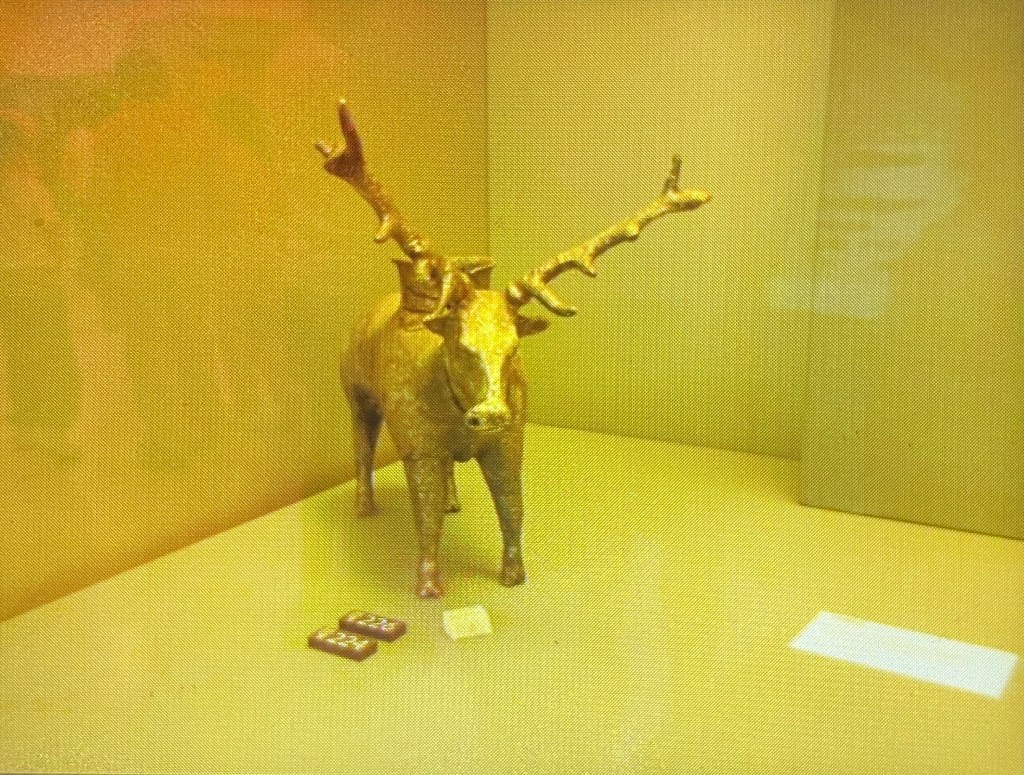
The sheer size of the building and all it has to offer is demanding in and of itself. Any curious individual could get lost amongst the halls, and I actually did a few times, wondering how many pictures I could take before my camera overheated and/or died. The museum is a true testament to the history of Greece and its material culture, but also the diversity of the regions that make it up. The result of impressive and extensive exchange networks lined wall after wall. One artifact that caught my eye in particular was part of the ritual vases-rhyta from Graves IV and V, Grave Circle A, Mycenae. A silver vessel in the shape of a horned deer. The vessel’s mouth is situated on the animal’s back, and it is said that a local craftsmen unsuccessfully attempted to transform the Hittite vessel into a libation vase by drilling a hole in the muzzle after it was gifted from the Hittite kings who dominated Asia Minor, to their Mycenaean equivalents.
Silver Hittite Deer Vessel Grave Circle A, Mycenae 16th C. BCE
This vessel is literally a direct connection between two of some of the most powerful civilizations of the time, and is essentially a manifestation of cross-cultural interactions and adaptation. This instance reminds me that we as people, our culture, and our livelihoods are constantly influenced by the “other” and have been from the beginning of time. Cultural exchange is immemorial and necessary for transformation. Otherwise we wouldn’t have nice things, like sushi pizza. While the attempt to modify the vase was futile, it reflects a shift. A curiosity for change. A desire for experimentation. The Mediterranean Sea served as a highway for numerous peoples, from Egypt to Persia. These interactions don’t go unnoticed and are very very well documented in leading to the adoption of various artistic styles, practices, and technologies. How cool is that? Greece is so incredibly diverse. In its archaeological record, its history, its culture, its food, its clothing, its language. Diversity drives society. It was true then, and it is now.


 Concordia CMLL Study Tour
Leave a comment