
By Leo Paniagua
Today was a day about mortality and trinkets. We explored the Arkadi Monastery, the Eleutherna Museum and the Agios Markos Basilica before breaking for lunch in the town of Margarites, where we encountered both a long strip of pottery workshops and a cat which was very happy to lick yoghurt off of my finger. This place was trinket central, and boy did I ever partake. Our last stop of the day was the Minoan Cemetary at Armeni.
Our first stop of the day, the Arkadi Monastery, was as harrowing as it was contemplative. The site of the Arkadi Massacre, the monastery’s construction itself is an amalgamation of its rich highs and tragic lows; the Venetian façade stands tall, featuring the original bells from the site’s construction, while exposed stone on the building’s rear shows evidence of the site’s destruction and reconstruction. I’ve noticed that more recent sites, especially monasteries, elicit more of an emotional reaction in a lot of us than ancient religious sites. At least one person cries, and I am often one of them. Not that you can tell; I make strategic use of my sunglasses.
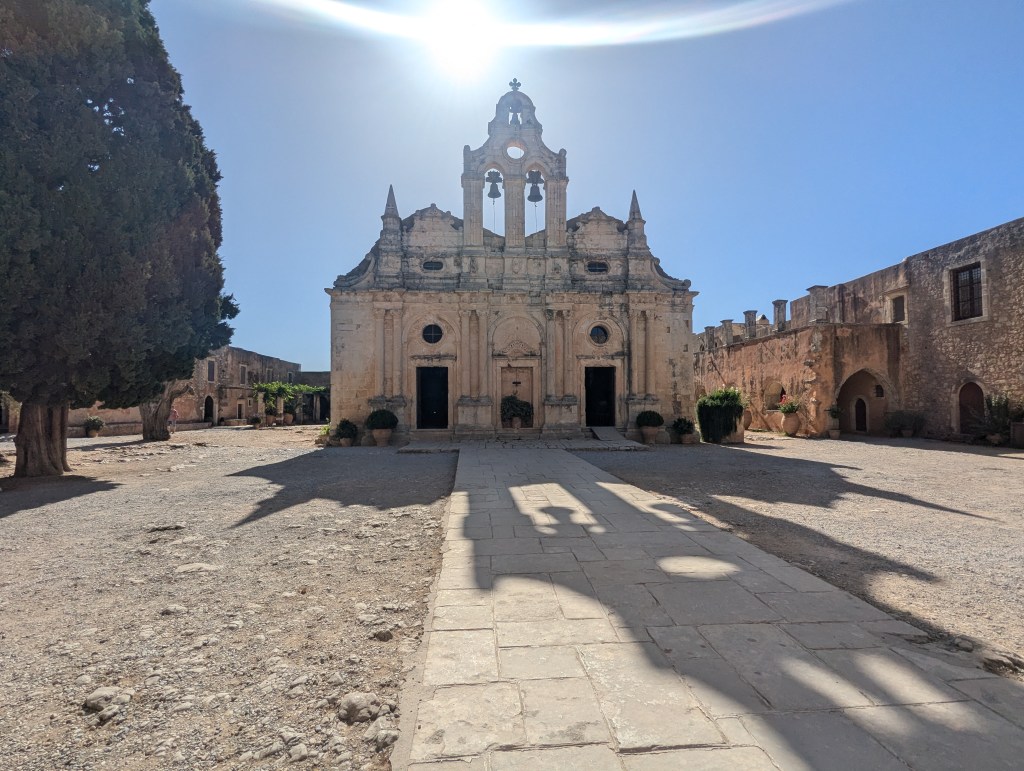
~The Venetian church at Arkadi.
I have a few thoughts. So many of the ancient sites we talk about and visit show the same evidence of destruction as was found here, but it’s only at the more recent sites that we react so strongly. I think that with the ancient sites, we have the convenient barrier of academia between us and the sites’ past. We don’t have an inherent understanding of the iconography, or the importance of the site, or the place it held in people’s lives like we do in the monasteries. Many if not all of us have, at least tangentially, a relationship to some form of Christianity. We know what it feels like to be in a church, and so we know what it would feel like for it to crumble around us. It is also still functional. It’s easy to project today’s occupants on the past, because in a lot of ways it feels almost frozen in time. Also. Monasteries are built to make you cry. So can you really blame us?
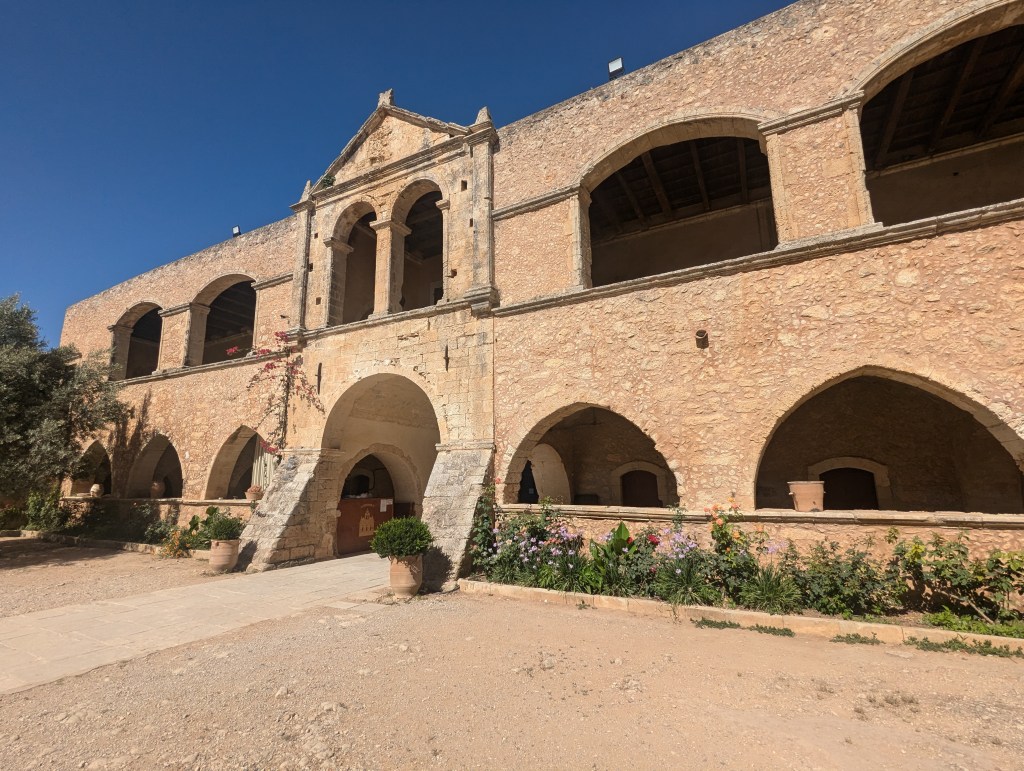
~Cellars, Arkadi Monastery.
The Eleutherna Museum was built in 2016, and it shows. It is small in its scope and delivers on its goal to situate and contextualize its contents. There were numerous highlights, including not one, but two revolving platforms, which housed concerningly ancient pottery. A certain museum expert among us was slightly concerned at the speed in which these platforms spun, but the effect was entrancing. I was most struck by the reconstructed funeral pyre, which showed a variety of grave goods as close to their original context as you can get in a state of the art facility. Most notably, it showed the multiple strata which would have covered the deposit, including the original ash and later layers (pictured below).
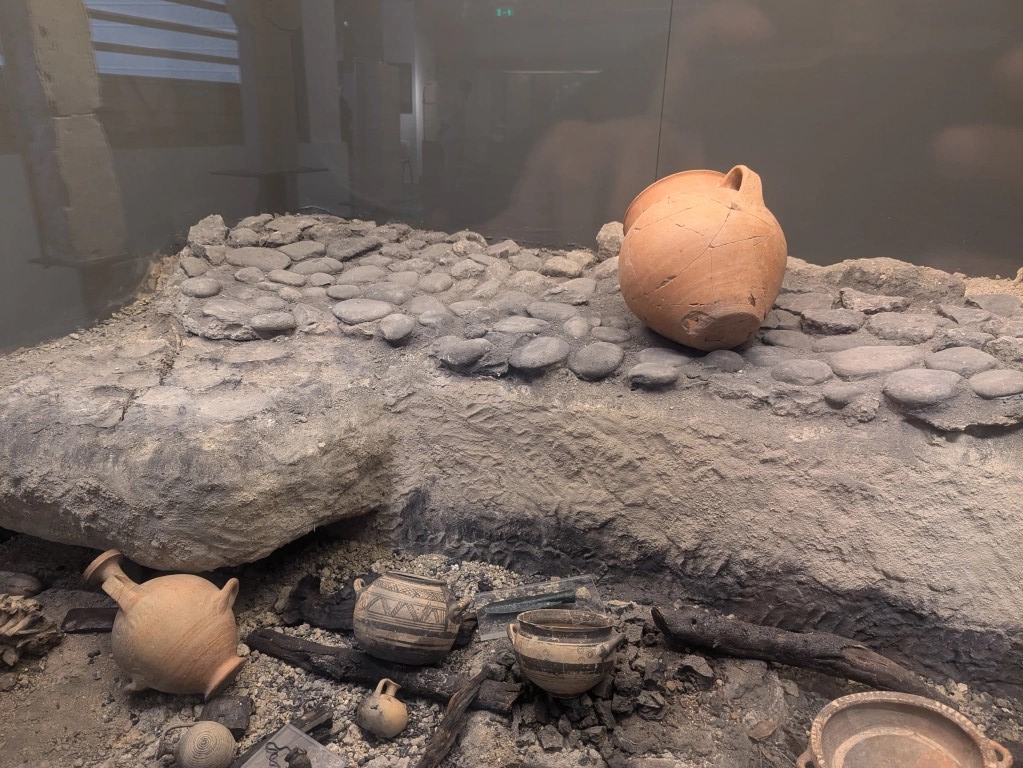
~Reconstruction of a funerary pyre, Eleutherna Museum.
The Minoan Cemetary of Armenoi was a town for the dead, laid out very much like one for the living. There were, at the sites’ beginnings, discrete ‘districts,’ segregating the dead into their individual classes. The distinction between a high class burial and a… well. Not low class burial. Lower classes don’t get rock-cut tombs, they get… dirt, or something.

~A LM III chamber tomb, Armenoi
The distinction between the classes of burials was easily discernable due to how much you had to squeeze your arms to your sides to wriggle into the tomb. And wriggle we did. For the smaller tombs, it was a very tight squeeze, and I am comfortable with the fact that I did not go all the way into the chamber. If jumpscared by a Minoan ghost, I would like to be able to turn and run, not try to crawl unceremoniously backwards. Was it cowardice? Was it self preservation? Who knows. What I do know is that I show no signs of being cursed thus far.
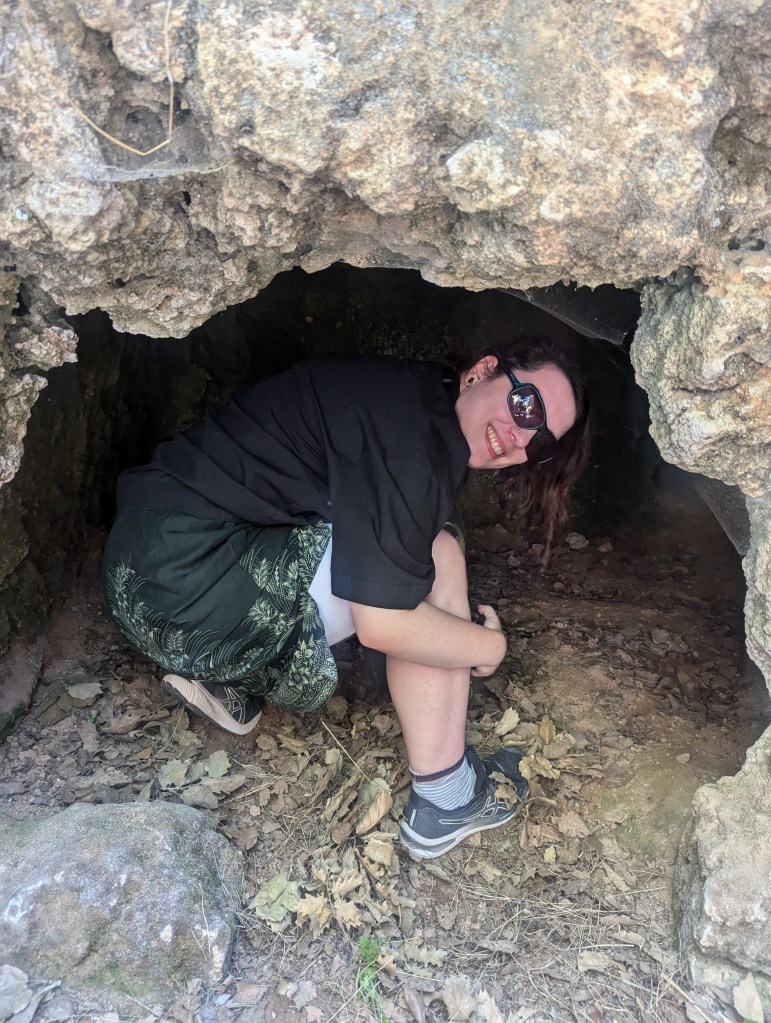
~Pénélope explores a chamber tomb, Armenoi.
 Concordia CMLL Study Tour
Leave a comment