
By Daniel White
The first destination upon our arrival saw us visit the archaeological museum of Rethymno whereby we were given the opportunity to see traces of the region’s history through different periods of occupation and development. Among the most significant of the objects found at the museum was the collection of Acheulean tools consisting of several medium size blades and cleavers made of stone. Dating to the Paleolithic period that spanned from 130,000 to 11000 BC, these tools served as a highlight within the museum in that, through their dating, one is given far more than simply the history from a local perspective but rather a global perspective of early human development that raises questions about prehistoric travel and settlement.
Following an early start to the day to mark our departure from Heraklion, we set out westward for a long drive along the coast. Traveling through the hills and coastal roads towards our destination of Rethymno, the beauty of the Cretan environment began to unfold as the ocean, maintaining its crystalline blue, served to emphasize the islands connection to the Mediterranean with communities spanning different sections of the coast. Among such settlements in the city of Rethymno, which finds itself situated in a beneficial area with productive agricultural lands water supplies to the south that enabled the region to experience a minor roman presence prior to its growth under Venetian control beginning the 11th century.
Once the museum concluded, a tour of the old town was given concerning the development of Ottoman control following the defeat of the Venetians during the Cretan war spanning from 1649 to 1680. The results of Ottoman control were shown throughout the tour as we were able to see the remains of a cultural shift that took place within the architecture of both the town and city fortress. Within the town itself, a number of homes were shown to have extensions in the upper stories that would have served as areas in which women of the house would spend their time in accordance with Ottoman customs. Furthermore, touring the grounds of the city fortress, the presence of Ottoman control became far more pronounced with the presence of the mosque dedicated to Sultan Ibrahim. It was converted from the cathedral shortly after he fortress surrendered. While the fortress itself had little in terms of plaques and informational sections, having the opportunity to walk throughout the complex and the mosque allowed for a great deal of insight into the cultural shifts that took place throughout the city. As a result, the city of Rethymno serves as a unique location among the previous stops throughout the study tour. With the presence of Paleolithic objects along with the remains of architectural features throughout the old town, one is left with a greater understanding of the cultural transformations that have developed throughout Greek history, making the city worth a visit.
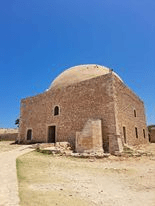
~Mosque of Sultan Ibrahim, Rethymno.
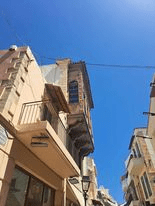
~Ottoman inspired architectural features, Rethymno.
 Concordia CMLL Study Tour
Leave a comment