
By Charles Noseworthy
Today, we visited several sites, the main ones being Phaistos, Agia Triada, and Gortyn. We took a lunch break in Matala and visited the museum for the general area. It was a jam-packed day!
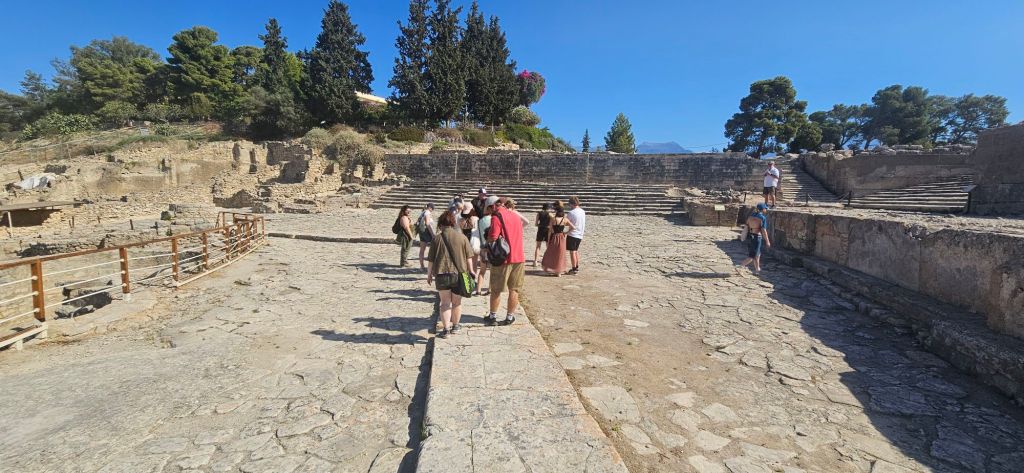
An hour had passed, and there it was, Phaistos palace. It is a huge site with several areas of interest, of particular interest in the central courtyard, where we see a platform that some scholars believe might have been used to for bull leaping and porticos where perhaps spectators could have watched what was happening in the court. However, it is from the western façade where we get the best view of the site as we can see the Protopalatial remains and the Neopalatial ones on top of different levels of strata. Additionally, we get a raised path through the western courtyard, which could indicate a path for religious processions. Finally, another interesting note is the masons’ marks found on site . These are unique to Phaistos, which would indicate at least mostly for the Neopalatial period autonomy from other states like Knossos as they are using their own customs and laborers. On the other hand, the fact that much of the palace is being used for storage could indicate that whatever products contained are being stored for a larger entity, perhaps Knossos? Overall, it truly is a fascinating site to visit and helps you understand the context of in which an interconnected palatial system existed long ago.
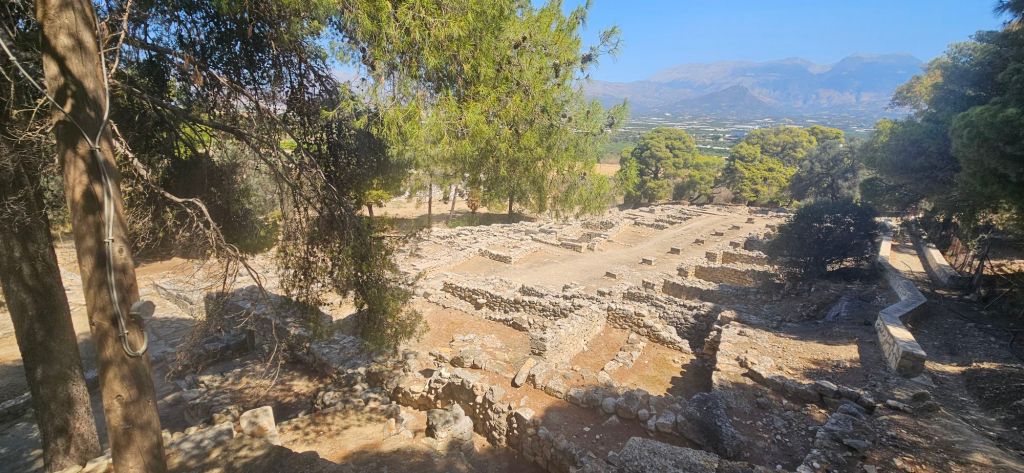
Shortly afterward, we made it to Agia Triada, a settlement roughly 5 minutes away by bus. Long thought of as a suburb or an extension of Phaistos, today, it is thought of as its own settlement apart from the aforementioned palace. It contains several levels, some of which can be confusing to see dating from the early to late Minoan periods. Notably, there is a villa on top of which has been built a megaron latter on. There are also the remnants of the town agora located in the village area of the settlements in which can be seen several shops. Most interesting of all is the elite housing, which contains ashlar masonry, a material often used in palaces indicating the status of the dweller. Finally, the villa itself contains gypsum on the floor, indicating the degree of wealth of the elite. Therefore, it’s clear that not only was there a palatial structure (administration), but additionally, it may be argued that this settlement was once more prosperous based on there being actual living quarters and more luxurious elements in the villa such as the aforementioned gypsum and the frescoes present.
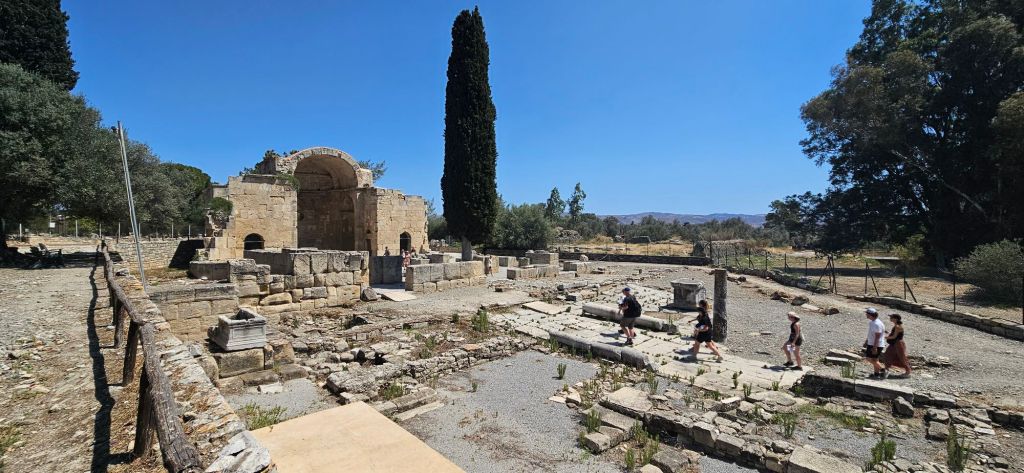
Following Agia Triada, we arrived at Gortyn, a huge settlement spanning 400 hectares containing Roman, Byzantine, and much more in terms of ruins. There is a theatre complex in which are written civil laws that were in when it was a city state. Originally, the building was a sort of city hall, but under Roman rule, it was turned into a theatre with the aid of several Roman emperors. On the same site, we can also see the Agios Titos church, a remarkable site abandoned in 670 AD due to an earthquake. It is said to hold the graves of two of the holy ten Christians put to death under the reign of both Decius, the emperor, and Decius, the governor of Crete. This is proven by the apse, which is outside the rectangle of the church, meaning that there were martyrs there. After a long trek through the “woods” in fear of Cretan snakes, we made it to the sanctuary of Apollo and the sanctuary of the Egyptian gods both under excavations. The first seems strange as it has no outer colonnade. Additionally, it has a heroön for some figure unknown at the moment. The latter shows the influence of Egypt on the Crete during the first century BC and is interesting as it may be a sort of “cheat” for Cretans as the Egyptians believe in an afterlife unlike the Greeks. This may be why Isis statues have been found.
Overall, I myself had a great time today. I learned plenty of things about the different sites and feel more educated about them. I especially enjoyed looking at the different drainage systems used to see the engineering skills used in each set of circumstances. I hope to come back one day to go more into detail myself.
 Concordia CMLL Study Tour
Leave a comment