
By Pénélope Gingras
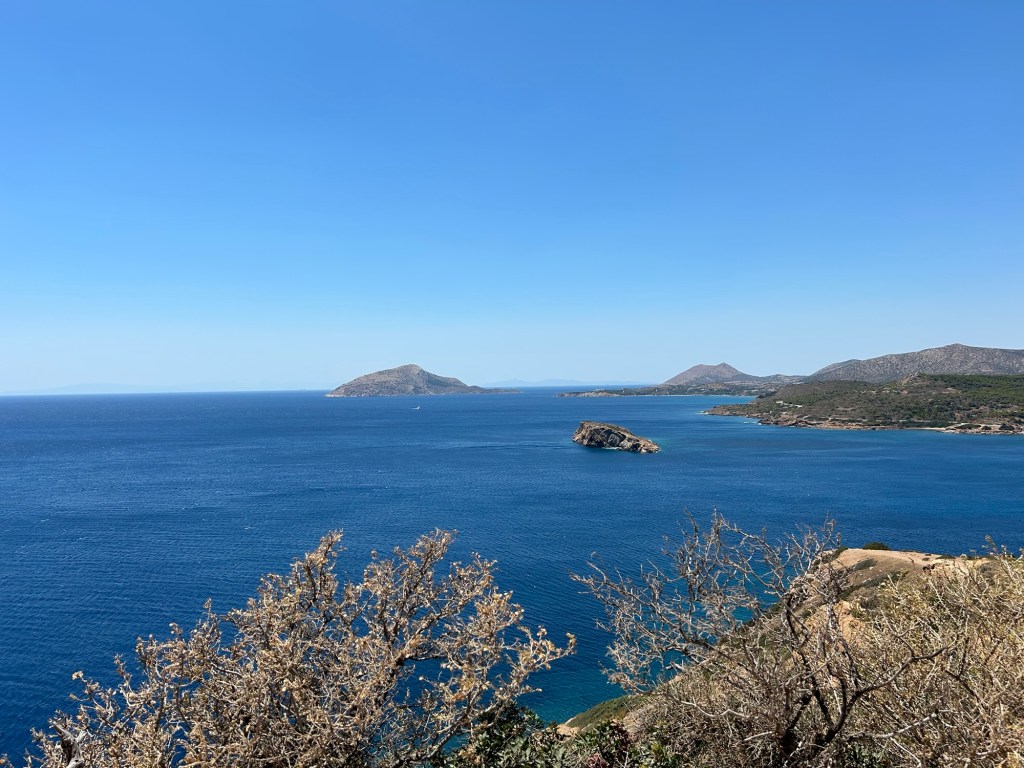
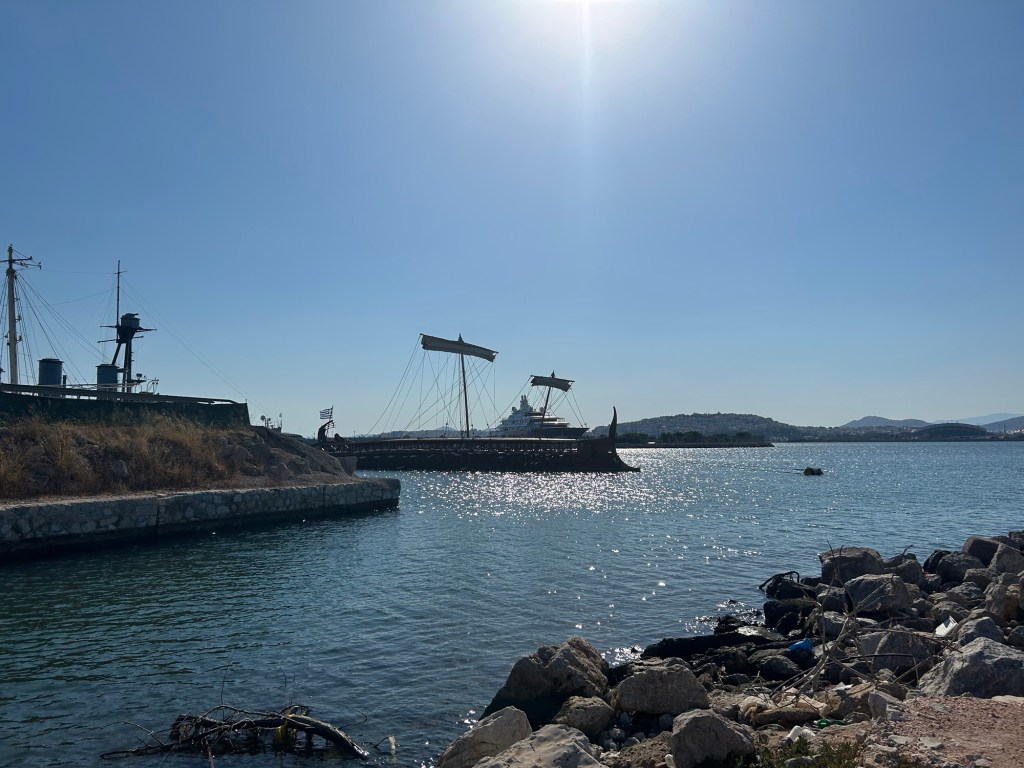
Our first stop of the day was at Brauron, which houses the Sanctuary of Artemis. We also went to Thorikos’s ancient theater, and the Temple of Poseidon at Sounion. In addition, we then checked out the reproduction of a Trireme at the Piraeus (its beak was gorgeous, truly) and we are ending the day with an overnight ferry to Crete.
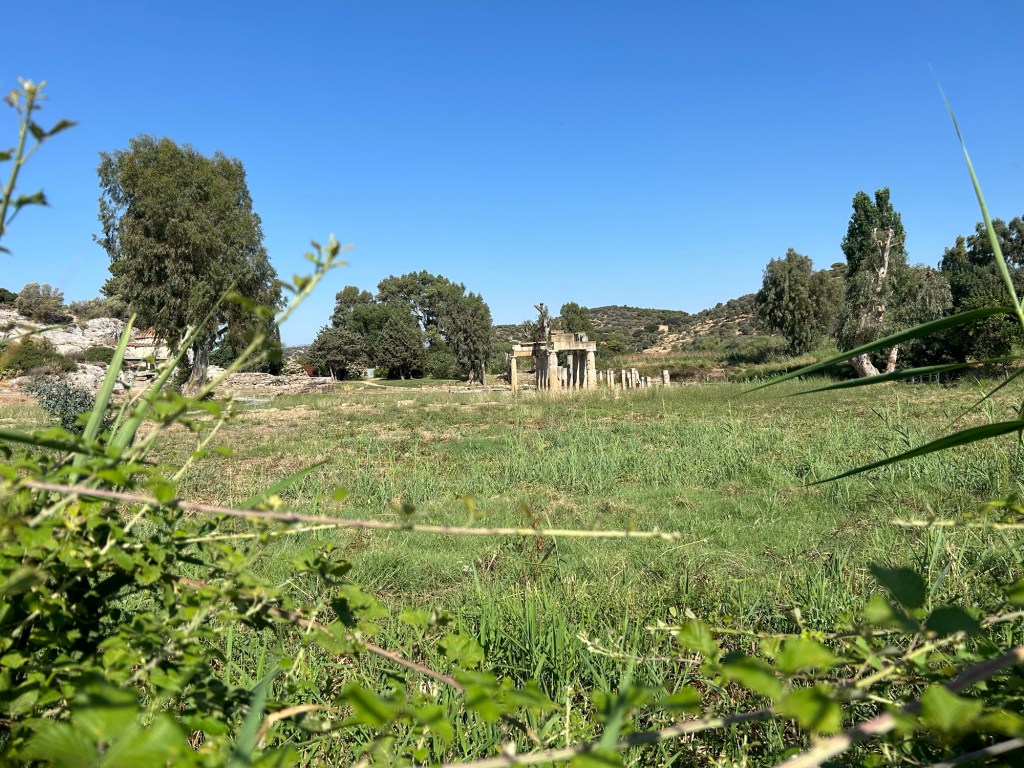
Our first site, Brauron, is in Attika and it was one of the twelves demes of Athens. In fact, when Athens unified its surrounding settlements and established itself as a polis, the Athenians also erected a smaller shrine dedicated to Artemis on the Akropolis in order to link Brauron and Athens together. Athens had also constructed similar subsidiary shrines for Dionysus and Demeter, since not every Athenian could travel to the sanctuaries scattered all across the Athenian polis.
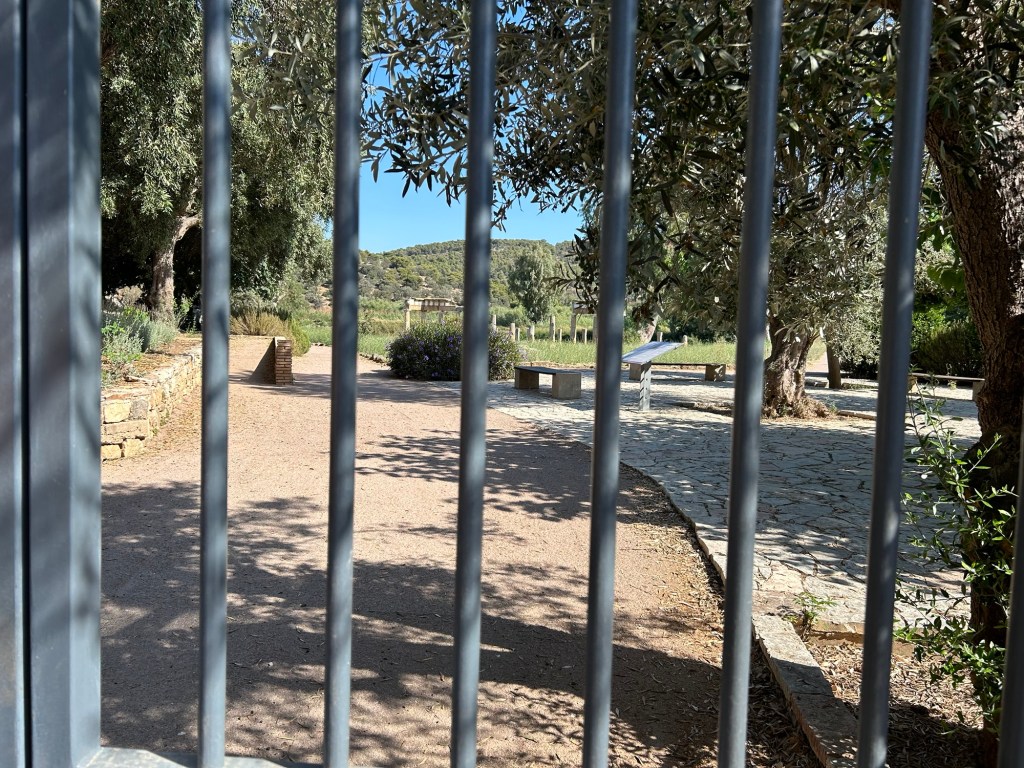
Upon our arrival at the site, we made lovely acquaintances with a firmly locked gate. The Sanctuary of Artemis was closed today, which happens fairly regularly in Greece. Sites are sometimes closed on Tuesdays, depending on previous traffic— it’s safe to assume not many people visited this site in May. Nevertheless, one of my classmates, Nava Camelot, had previously done some research on this site and presented her findings in front of the fence.
Nava shared that the site itself is shrouded in mystery, especially since its primary researcher, John Papadimituou, died on the site (shocking!) and his research notes weren’t publicly published. Modern scholars turn instead to his preliminary research and Ancient Greek playwrights, such as Euripides and Aristophanes. Euripides wrote in c. 414-412 BCE Iphigenia in Taurus and Aristophanes wrote in 411 BCE Lysistrata. Both plays mention some of the rites of the cult of Artemis, which may help better understand the function of the buildings and votive offerings excavated on the site. The juxtaposition of both material culture and literary sources is absolutely magnificent, and it is a great example of cross-discipline evaluation. I’m particularly fond of it, especially when theater is involved!
According to those plays, one of the festivals celebrated at Brauron was called the Arkteia, which derives from the Greek word ᾰ̓́ρκτος (arktos), bear. This appears to have been a ritual of transition, where young girls would participate and transition to the next stage of their life. The little girls would either be called little bears or priestesses. This would also coincide with the myths about Iphigenia, Agamemnon’s daughter, who was demanded as a sacrifice by Artemis. Versions differ, but some mythological stories state that at the last minute, Artemis swooped in and substituted Iphigenia for a bear. There is also a shrine to Iphigenia on the sanctuary grounds at Brauron, and archeologists uncovered inscriptions detailing offerings given to both Artemis and Iphigenia. Votive statuettes of boys and girls wearing bearskins were also found on the site, which loosely corroborates our literary sources when they say girls used to dance at the Arkteia wearing bear skins.
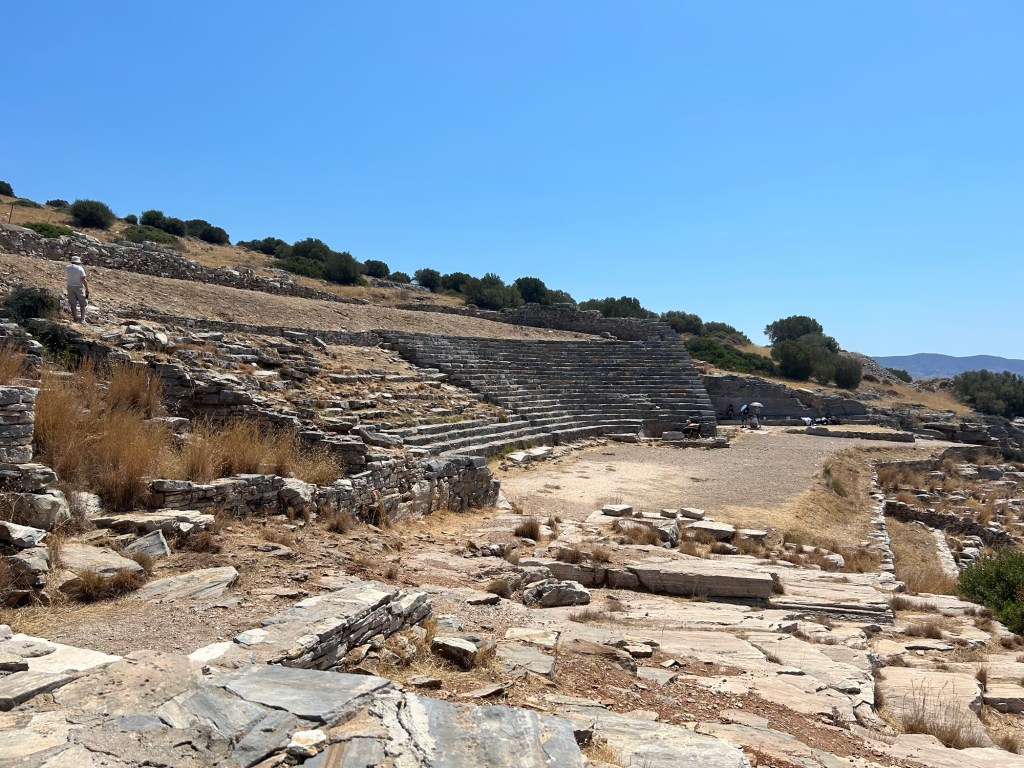
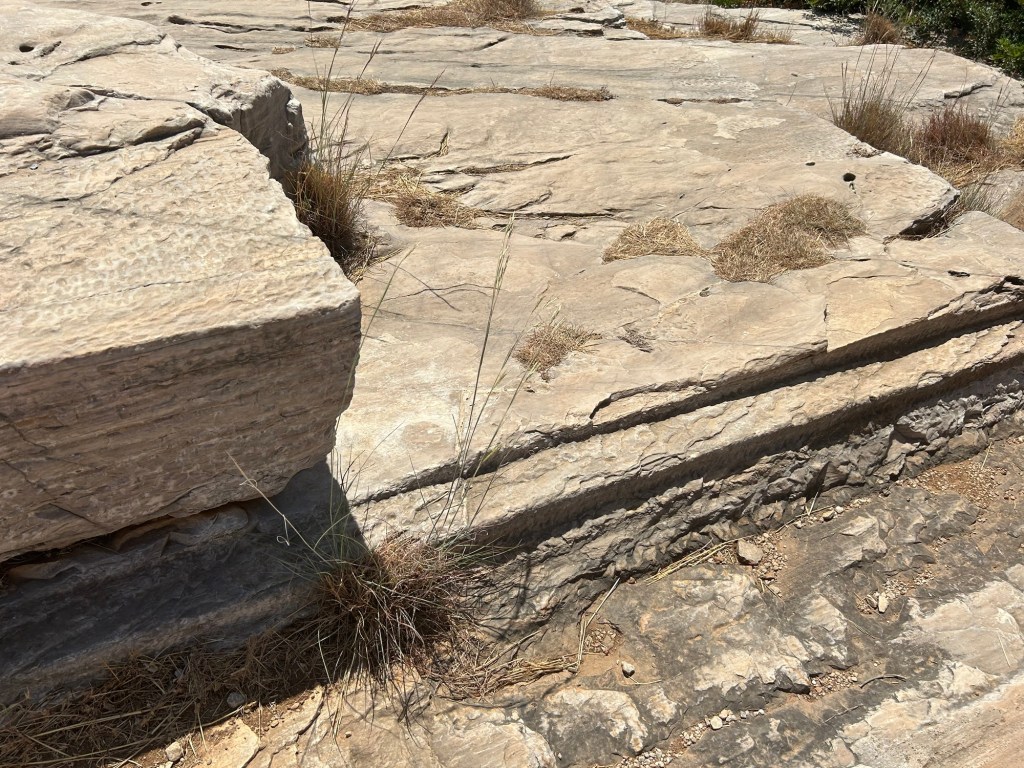
Speaking of plays and theaters, our next stop was the ancient theater at Thorikos. Dr. George W.M. Harrison gave us a site lecture about the theater in question. The ancient theater of Thorikos was serving double-duty as both the theatre and the bouletarion. Indeed, an inscription dating from 509 BCE was found which indicates that it was used for political meetings since they didn’t have a town hall. The site itself was used as a quarry when they built the theater, and it is still possible to observe chisel marks and stone cuttings around the theatre.
The building has twenty-one rows of seats, and there is even evidence of scaffolding at the top. It appears that perhaps twelve rows of wooden seating, constructed out of wood, would have loomed above. Next to it, it seems like there was a temple dedicated to Dionysus, which isn’t surprising since drama and theater was associated with him and his cult.
The theater at Thorikos is also the oldest surviving theater we have thus far, which is pretty exciting. It’s also quite possibly the place where the mysterious satyr plays were first performed, roughly around 532-525 BCE, which is even more exciting! According to ancient literary sources, the satyr play in question was called The Wrestler, but no synopsis of it survive to date. We have a later satyr play called The Wrestlers, and we have some of its plot and a couple lines. We are able to infer what the first satyr play could have been because of that. Another later satyr play, called Hercules and the Lion, is another contender for what the first satyr play could have been.
Satyr plays were comedies, which were made to make fun of serious drama and provide comedic catharsis. Essentially, they would normally have had a chorus composed of satyrs. Not to be confused with the Arcadian god Pan, who is half goat and half man, Ancient Greek satyrs usually have the ears of a horse and the legs of a horse. I know, I was surprised too!! They were also bipeds, which are different from centaurs. Pop culture satyrs, such as those in fantasy literature, video games and even Dungeons and Dragons tend to have Pan-looking satyrs. That’s what I usually think of when I picture a satyr, not a horse! They also had exaggerated erect genitalia and were interested in nothing else than sex and wine. They are also associated with Dionysus and his cult.
According to the textual information we currently have, it is possible to reconstruct what The Wrestler more or less could have been. If we look at what we have about The Wrestlers, it could have been about a group of satyrs who decided they’ve had enough of sex, wine and Dionysus. Instead, they decide to try their hand at being Olympic athletes, specifically wrestlers, and they seriously pursue that goal up until the last act or so until all of that is thrown off a cliff. Since they have no idea what they are doing, they give it up and return to their lives as Dionysus’ devotees. The second possibility comes from the satyr play Hercules and the Lion. Hercules is wrestling the Nemean lion while the chorus of satyrs is just getting in his way. The satyrs keep giving him bad advice and bothering him, so Hercules is the straight man to the satyr’s comic relief.
If you’re interested to learn more about satyr plays like I am, Dr. George W.M. Harrison recommended academic readings on the subject to me. Ralf Krumeich, Nikolaus Peckstein and Bernd Seidensticker’s book Das Griechische Satyrspiel, published in 1999.

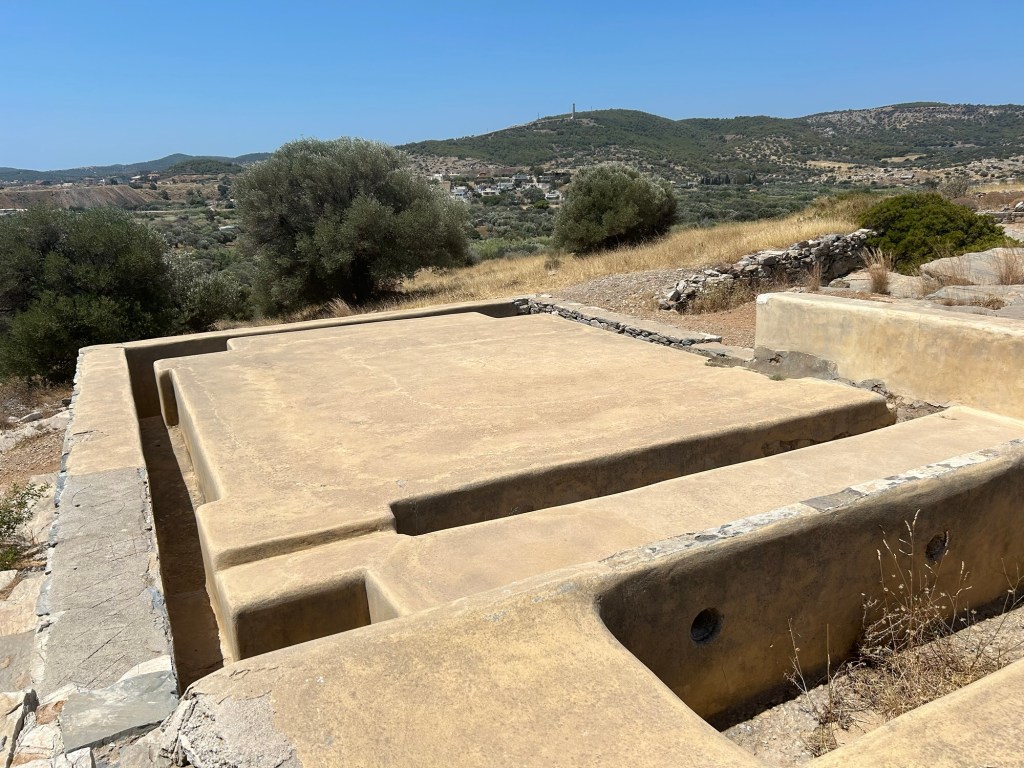
Dr. George W.M. Harrison also taught us about mining silver in the ancient world, since we came across a reproduction of an ore washing table near the Thorikos theater. It was basically a death sentence, since the slaves who worked there had to come into contact with lead and sulfur. If they survived the lead poisoning, it was the sulfur that got them.
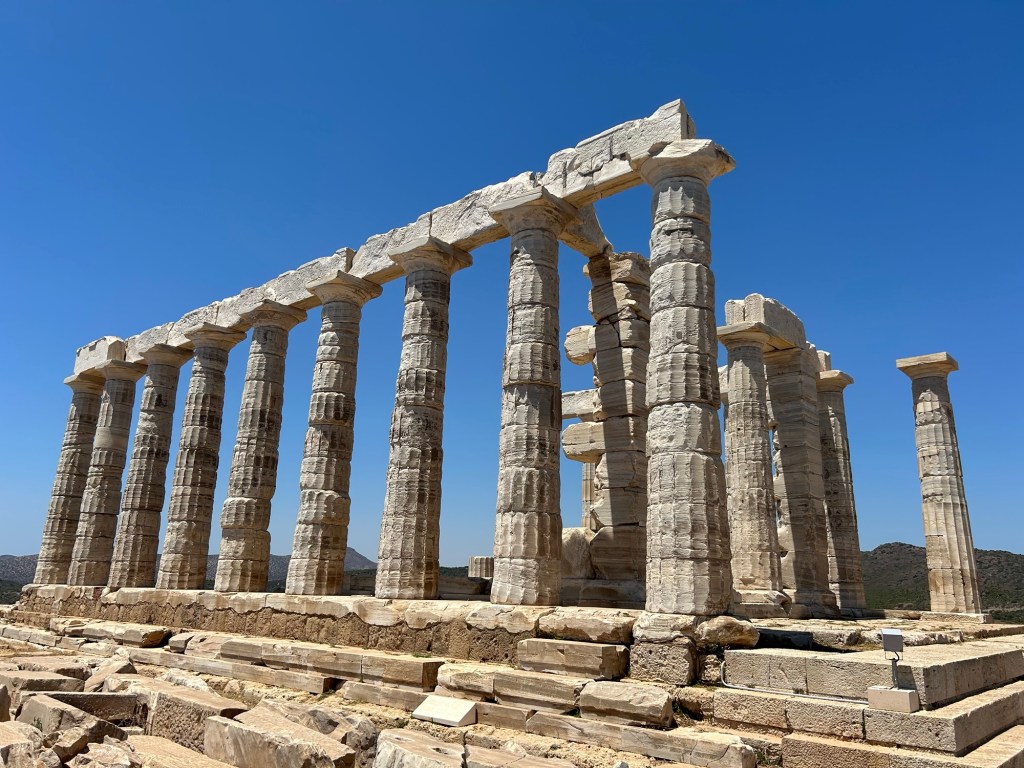
We also visited the Temple of Poseidon at Sounion. It was very windy, on top of a cliff overlooking the ocean. It was absolutely beautiful and it reminded me of lighthouses. Dr. Jane Francis gave us a lecture on the temple itself, which was really fun! The Archaic temple was built out of limestone, and the Classical one out of marble— both from local sources. The Sounion Kouroi were also found buried there, but it’s unclear as to why they were buried. One school of thought is that they were buried to protect them from the Persians during the war. The second suggests that they were buried after the Persians destroyed the temple, as though they were starting over with a clean slate before they rebuilt the temple out of marble.
We’re finally heading to Crete today, and I’m so excited to finally run around Minoan ruins! Jayde Clement, one of my friends and classmates, presented her research on Sir Arthur Evans on the ferry today. It’s nice to have a refresher of how the Minoans were first discovered!
I’m so excited to sleep on the ocean tonight, I’ve never done that before!
Extra: Sherd Nerd Alert!!
One very important thing to note about Greece is that there are pieces of broken pottery everywhere. Those are called sherds, not to be confused with ‘shards’ which are broken pieces of glass. One very fun thing to do while exploring archeological sites in Greece is to look for loose sherds on the ground, and try to identify them. Today at Sounion, I found a beehive sherd!
Normally, Ancient Greek pottery is undecorated and smooth on the inside if no one will see it (like for jugs and amphorae). An ancient beehive is basically an elongated pot, with deep horizontal grooves along the inside of the vessel for the bees. This particular sherd had horizontal lines on the inside and was plain on the outside. We can tell which side is the outside or the inside depending on the curvature of the sherd.
As a person who loves bees and honey, this made me so happy. I hope someone else who loves bees will find it in Sounion as well, and be just as excited as I was!!
Τάς μελίσσας στέρξωμεν! 🐝
🐝 Let us cherish the bees!
 Concordia CMLL Study Tour
Leave a comment