
By Athena Aguirre
We began our day with what looked like a pretty good breakfast. I did not get a chance to properly try it as I woke up pretty late and had to rush my morning routine. Following a long bus ride we arrived at the Rio-Antirrio bridge. The world’s largest suspension bridge, connecting the Peloponnese to the mainland across the western end of the Gulf of Corinth. Many significant naval battles took place near where this bridge would be built; the battles of Naupactus, Actium and Lepanto. The bridge itself was commissioned in 1990 and inaugurated in 2004. After stopping at the bridge we headed to Delphi. The main subject of this blog.
Delphi was a a panhellenic site, and by the sixth century BCE it would be governed by a group of poleis called the Amphictyonic League. In addition, it housed an oracle called the Pythia. The sixth century BCE also saw the rise of Delphi as a site for competition among aristocrats, who would give expensive votives at Delphi; this would expand to include Anatolian kings. All of this meant that Delphi, by the sixth century BCE, had become an important site in the Greek world.
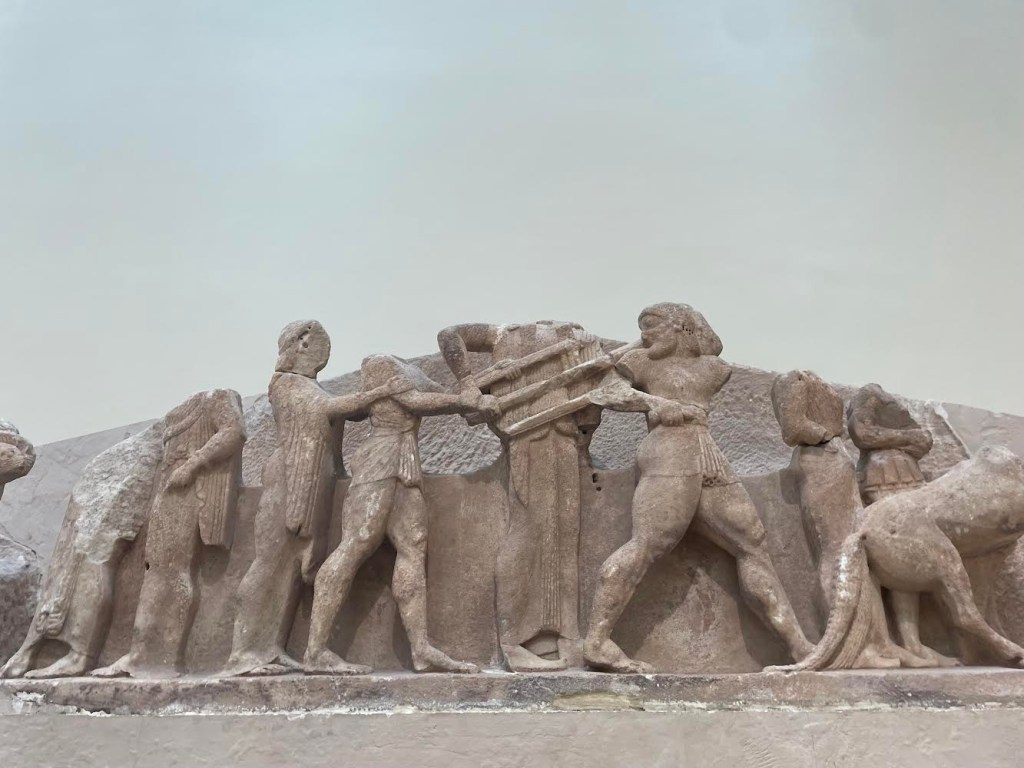
Turning to the mythological side, Delphi has a lot of interesting myths surrounding it. According to one, Zeus released two eagles and as their paths crossed at Delphi one of them dropped a rock. This revealed Delphi as the navel of the world. The Homeric Hymn to Apollo recalls that Apollo killed the serpent Python (son of Gaia) to establish an oracle and worship of his own at Delphi. Another myth, which is depicted in the Siphnian treasury, is that of Herakles trying to unsuccessfully take over the oracle. Furthermore, it was believed that Apollo did not stay in Delphi all year long. Dionysus would live in Delphi during winter.
Where myth and history intersect is in the architecture of treasuries. As we move along the sixth and into the fifth century BCE we see the creation of treasuries at Delphi. This is the result of poleis trying to appropriate individual offerings and turn intra aristocratic competition into intra poleis competition. With this we see the depiction of myths in treasury’s metopes, friezes, and pediments. The Siphnian Treasury has a panhellenic appeal, it depicts the twelve Olympians, alludes to the Trojan war and recalls a Delphic myth.
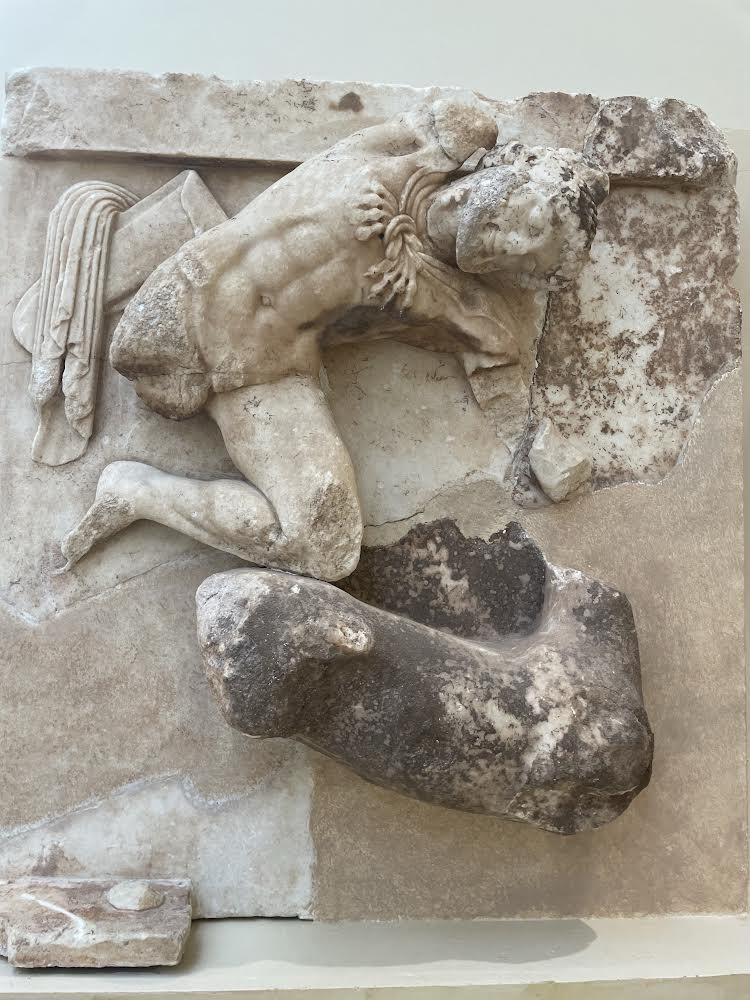
On the other hand, the Athenian treasury tries to juxtapose Theseus and Heracles. It’s worth keeping in mind that this treasury might have been built around the time Athenian democracy was in its infancy and was trying to find legitimacy. A way in which Athenians tried doing that is the aforementioned juxtaposition. Theseus was not a very well known hero before the rise of Athenian democracy and his six labours depicted in the treasury’s metopes parallel those of Herakles. Therefore by juxtaposing them Athens is stating that their local hero, Theseus, is as heroic as the panhellenic Herakles. Athens is also stating that their new political system works very well as it is capable of providing the money for building the treasury; which is on a very good location in the sacred way. I find it important to emphasize that Theseus would be the first hero one sees as they walk through the sacred way, further showing his importance. Therefore, the Athenian Treasury shows the important place that myths had at Delhi as they could be used to create political statements.
Overall, this day was really fun. I enjoyed being able to visit Delphi and the bridge was a nice impromptu stop. There is also a lot of really interesting architecture about that bridge that I did not mention because I wanted to focus on Delphi, but its also really cool.
 Concordia CMLL Study Tour
Leave a comment