
By Léo Beaudoin
Today was a very nice day. It began with a long bus ride as we went up into the mountains to visit the temple of Apollo Epicurius at Bassae. On the way there, we were fortunate enough to pass in the rural parts of Greece, allowing us to encounter of group of goats passing by, accompanied by their shepherd and his dog. The shepherd also tried to place one of the goats on the bus, which was rather funny. The road in the mountains was very sinuous, so a big thank you to our bus driver is needed for getting us there safely and rather smoothly as well. At the site, Cassandra gave a very interesting and informative presentation about the temple. It was especially interesting to learn about the uniqueness of the temple for its time with its combination of the three Greek orders.
After leaving the site, we made our way back down the mountains, and onto the site of Olympia. Once there, Hannah gave a fascinating presentation about the temple of Hera, also called the Heraion. It was really interesting to learn that women also had a physical activity they could participate in, seeing that, except in special circumstances, they were not even allowed to watch the Olympic games. Additionally, it was interesting to compare the history of study for both sites, as they were excavated and published very differently, as the artifacts from the Heraion were kept at Olympia, and not taken to the British Museum, unlike at Bassae. After walking through the site, and learning more about the temple of Zeus at Olympia, we made our way to the archeological museum of Olympia, followed by the museum of the Olympic Games. Both museums were very interesting.
After this, we made our way back to the hotel, where most students attended a traditional Greek dancing class. The day ended with a buffet-style dinner at the hotel.
However, the highlight of today, in my opinion, was the archaeological museum of Olympia. More specifically, it was seeing the pedimental sculptures of the temple of Zeus. Aside from being rather well preserved, they provided extremely interesting information about how sculptures were changing in the Classical Period. For example, the Western pediment, depicting the Centauromachy, was very fascinating to observe in person. It was especially interesting to contrast the facial features of the Lapiths and the centaurs. As the Lapiths were depicting in the severe style, faces void of expressive emotions, the centaurs were depicted in pain with their mouth open. It truly reflected the differences between the “good” Lapiths versus the “bad” centaurs. Additionally, these sculptures were specifically interesting in the way that they showed different ranges of motion. Although quite exaggerated, it was still interesting to see how the centaurs’ torsos contorted as they grabbed the women and fought off the men. All-in-all, it was a fun day, allowing us to see some of the Classical period’s most impressive temples.
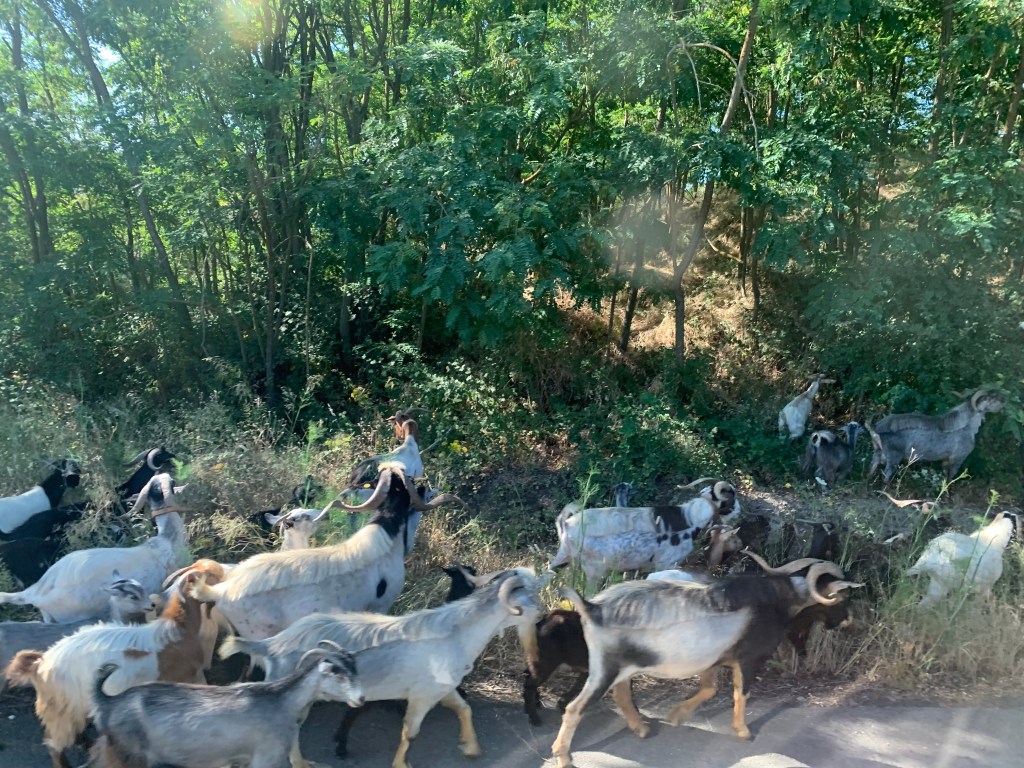
~The goats on the way to the temple of Apollo Epicurius at Bassae.
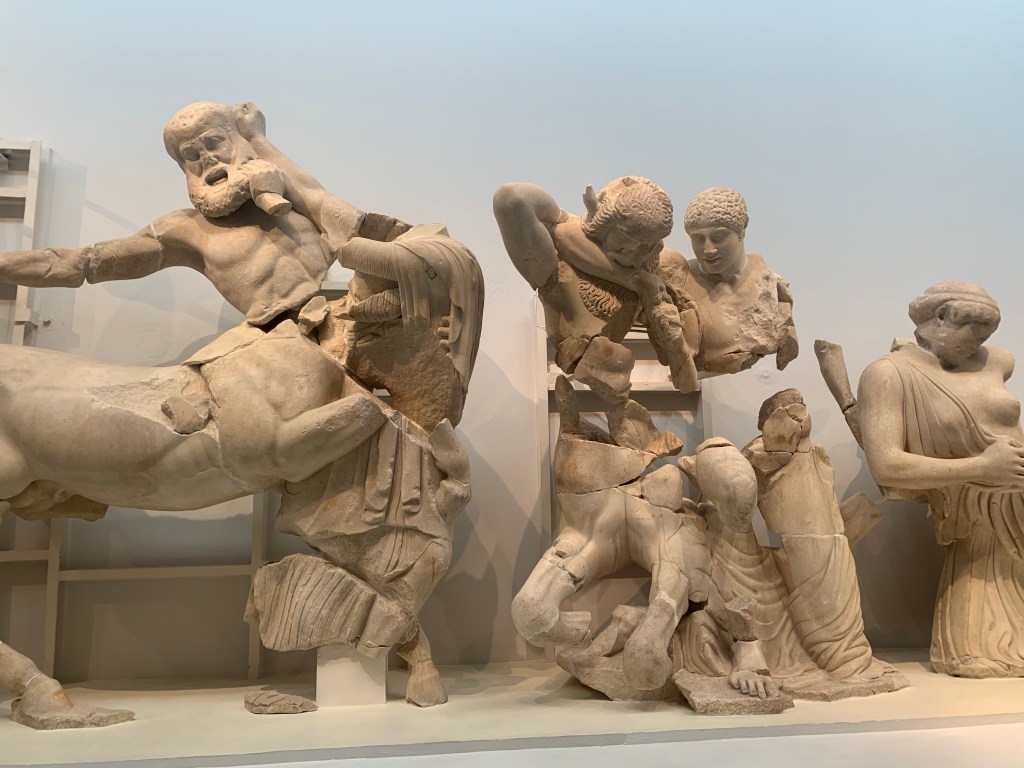
~Pedimental sculpture of the Centauromachy, depicting Centaurs fighting Lapiths, from the temple of Zeus at Olympia.

~Pedimental sculpture of the Centauromachy, depicting a centaur grabbing a Lapith woman, from the temple of Zeus at Olympia.
 Concordia CMLL Study Tour
Leave a comment