
By Aphrodite Wojcik
Today was an amazing day. We just recovered from a heatwave going from 43°c to 29°c today. We were unable to visit the ancient site of Sparta yesterday however we were able to enjoy the site today around 8am. This site included the Ancient theater and acropolis of Sparta, Sparta is located in the Lakonia region, and its surrounded by giant mountains. Because of the mountains and Sparta’s strong military they did not need to build fortifications around the city. The Spartans were especially known for their military services. They had a military governing state in order to keep their city in control since their state mostly functioned with slaves and laborers. Surprisingly, the women were treated equally to men. While they were encouraged to produce more boys for the military state; they could freely live, work, participate in homosexuality and own land! Sadly, the Spartans did have bad practices of throwing “defective babies” into rivers and off of the mountains so that their state could continue to become the strongest. This was in part the downfall for their society. They did not populate enough and their military became weak, and tragically the Romans eventually took over. After learning about the Spartans, we walked around the site up to the ancient theater where we had been informed that it had been worked on by the American Greek archaeologist and carried out by the British Archaeological School at Athens. We were fortunate enough to see people working on excavations while touring. This theater was linked to the emperor Augustus and has typical features of Roman amphitheaters. Supposedly if people wanted to whisper they would have turned facing the crowd so that their voices wouldn’t reach the stage. We then explored the site admiring the history before heading into the modern city of Sparta to walk 10 minutes to the Temple of Artemis Orthia. This site was presented by Léo Beaudoin who gave great details about the site. He mentioned how it was first discovered by the French when they found artifacts in the Evrotas/Eurotas River. It was then excavated by the British School in Athens from 1906 to 1910 led by Richard M. Dawkins. It revealed altars, votive offerings, pottery, and an arena by Romans. There was religious activity there from the 9th century BCE to the 4th. Léo also mentioned that in the 6th century BCE they had a flooding that created this sort of protective layer of sand on the artifacts at the site and eventually led to a rebuilding of the site. Then a Roman theater was finally built at the site during the 3rd century CE. What also piqued my interest about this site is learning about what kinds of rituals were done here by priestesses in honor of Artemis Orthia. Young boys would be publicly flogged to show their endurance and role as young Spartans. Some rituals included dancing, singing, contests, and performances. Funny enough, there is apparently one ritual at the site where the men were encouraged to steal cheese from the altars and other men had to defend the cheese from the thieves. Thank you Léo for teaching us this! After this wonderful site we bused around 2 hours to Pylos to see the Palace of Nestor and the Tomb of the Griffin Warrior. The Palace of Nestor was breathtaking, it was probably one of the bets-kept excavated sites that we have seen so far. What’s so special about this site is that it is perfectly located on a high mountain overlooking the sea which makes it good for trades, and it is highly suspected that a Minoan civilation was settled here, or some sort of Mycenaean settlement with Minoans influences since the palace was idetincal to a Minoan palace layout. I would not be surprised if they were Minoan since they are so close to the sea. We also got to see a tholos tomb, but we did not hear much about it.
After that Kayla Carruthers had her presentation on the shaft grave, the Tomb of the Griffin Warrior. Here the university of Cincinnati with the American School of Classical Studies at Athens Led by Jack L. Davis and Sharon R. Stocker (who we got to meet today! ). This grave was unique compared to most graves because it was found with all the artifacts and grave goods in there!! Nothing stolen! There was a preserved male body, a detailed ivory plaque, weapons, seals and jewelry. We then ended our day at the Philip Hotel next to a stunning harbour in Pylos.
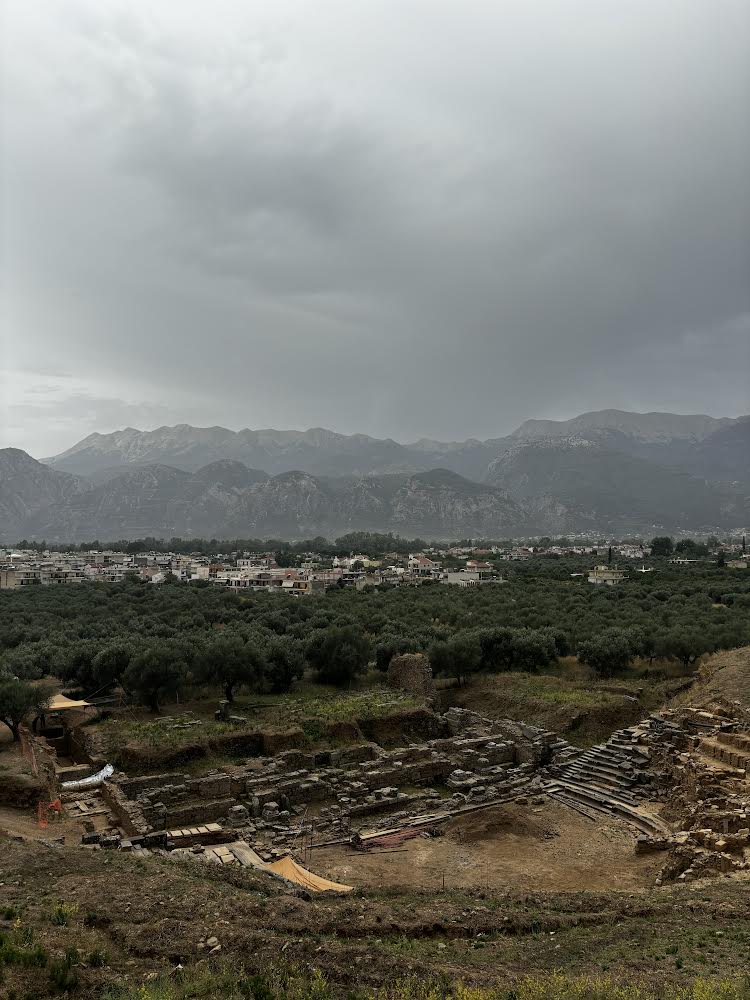
~The theatre at the sncient site of Sparta.

~Central area of the Palace of Nestor in Pylos.
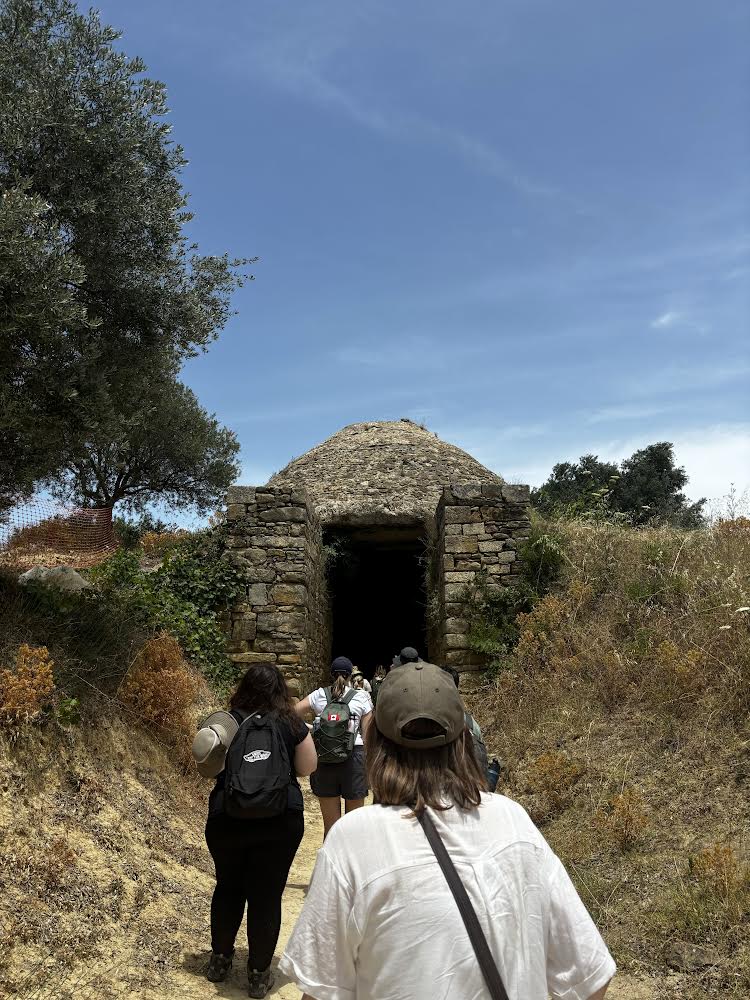
~The tholos tomb at the site in Pylos.

~The sunset view from Philip Hotel.
 Concordia CMLL Study Tour
Leave a comment