
By Cassandra Prete
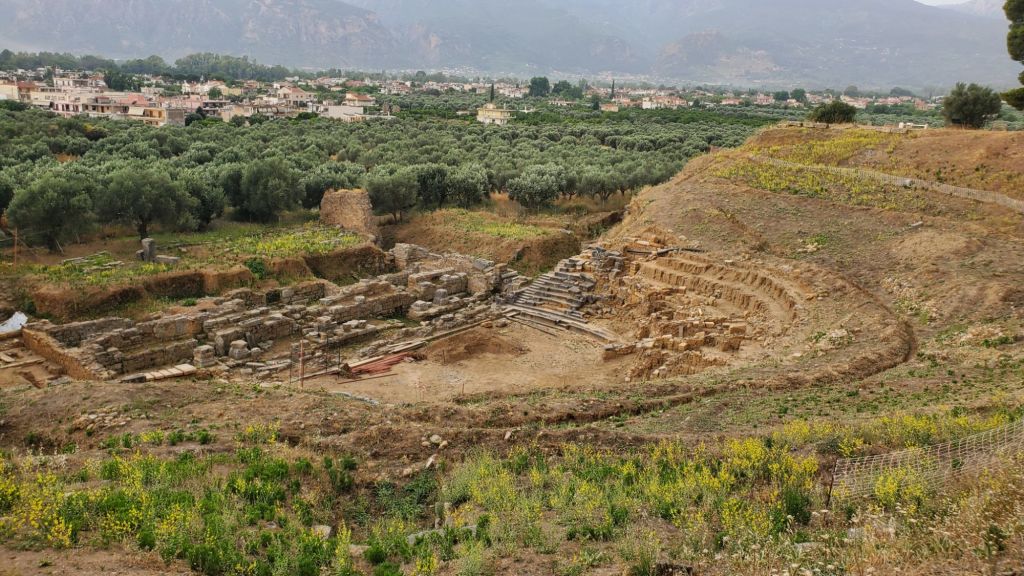
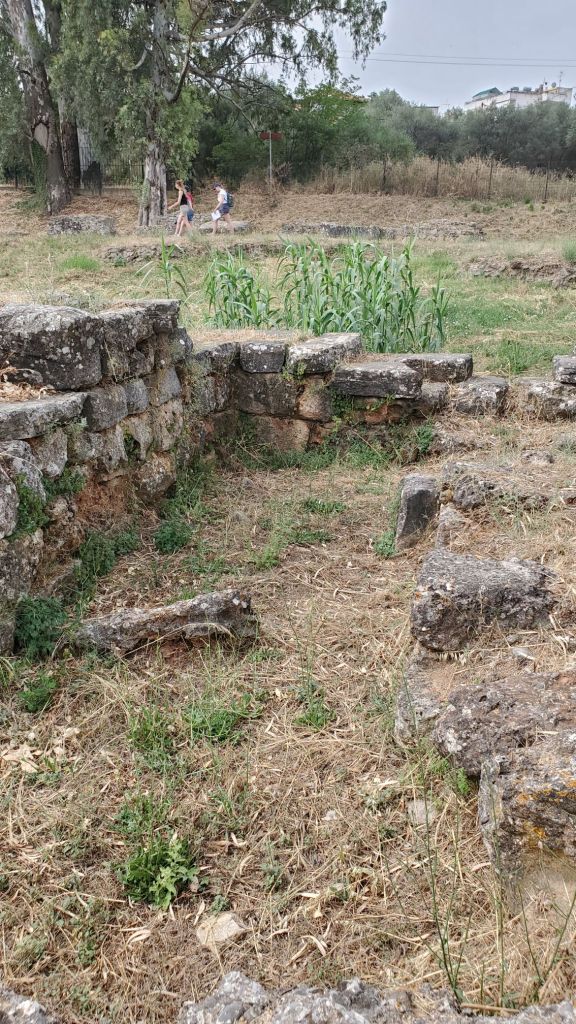
We began our lovely day at the ancient site of Sparta, where we got a brief introduction regarding the area of Sparta and who the Spartans were by Dr. Buell. He explained how Sparta was a society that heavily relied on eugenics, therefore causing the population to be low in number. He explained how the Spartans followed the Archaic style for sculpture, however art was later deemed as secondary with the rise of military. At the site of Sparta, we got to see three crucial parts of the site: the round building, the agora, and the theatre. While we were at the theatre, Dr. Harrison provided a highly informative explanation of what we were observing, where he mentioned how the acoustic degree for a Greek theatre was 180 degrees and the acoustic degree for a Roman theatre was 181 degrees, and how that singular degree created such a difference in acoustics. Afterwards, we walked offsite to the site of the Sanctuary of Artemis Orthia, where Leo gave a fantastic, very well detailed presentation about the site.
After a quick rest stop, we were brought to the Palace of Nestor, where we got to walk along an awning, getting an overview of the layout of this palace. We got to see the separation of each room that many of us have only seen the drawn plan of. The site itself was very informative, as there were tablets describing the section of the palace we were looking at. At this site, Dr. Buell gave a brief history of the study of the site, explaining how archaeologists were aware
of the site of Pylos, but did not uncover it until 1939. Carl William Blegen was responsible for this discovery, however his excavations were put to a halt due to the Second World War. He was able to return to the site in the 1950s, once the war was over. At this site, he uncovered more than 1,000 Linear B tablets, as well as a number of frescoes. These Linear B tablets informed archaeologists of what was entering and leaving the palace. As well as this, it was uncovered that rooms 23 and 24 were rooms associated with perfume and the manufacturing of perfume, as can be seen by a variety of pithoi and Linear B inscriptions. At this site, Kaylah gave an incredibly detailed presentation on the tomb of the griffin warrior, where she was surprisingly given the opportunity to talk to one of the archaeologists who worked on the site and provided her with images from the excavation, as the site was only discovered in 2015.
Our final stop of the day was the Mycenaean Tholos Tomb, where we got to enter the actual tomb and view its style of development. This site was more modest compared to the Treasury of Atreus that we saw a few days ago, however one difference is that this tomb had a very clear section mean as the resting place of the body.
To conclude our short day, we relaxed by the beach, where we got to swim in the ocean and enjoy the beautiful weather of Greece. It gave us a moment to soak in the fact that we were all together in Greece, and appreciate how special this moment is.
The site that I appreciated the most today was the Palace of Nestor. Having only ever seen images of this Palace, it was incredible to see how large it truly was, and how much remains intact considering it is thousands of years old. It was unfortunate that we could not walk across the palace itself, but it was still incredible to see it from above and notice small details, such as a large amount of pottery in one room, and a painted bathtub in another. I also appreciated the amount of information the site provided, allowing individuals like myself to read and learn on my own.
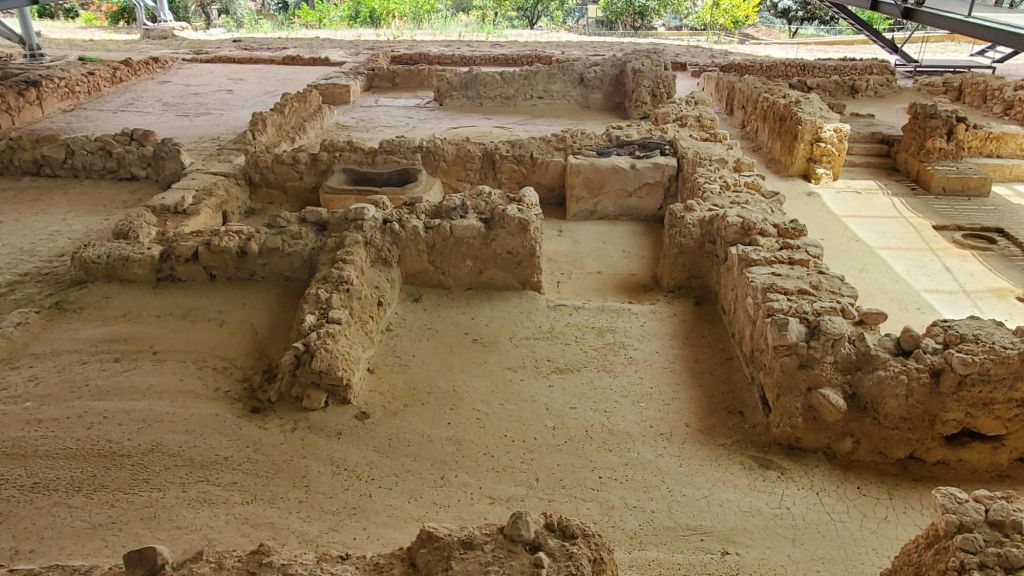
~A room with a bathtub at the Palace of Nestor.
 Concordia CMLL Study Tour
Leave a comment