
By Gabriel Gagnon-Cady
On today’s agenda, we visited several bronze age settlements, a sanctuary to Asclepius, and ended the day with a visit to an orange orchard.
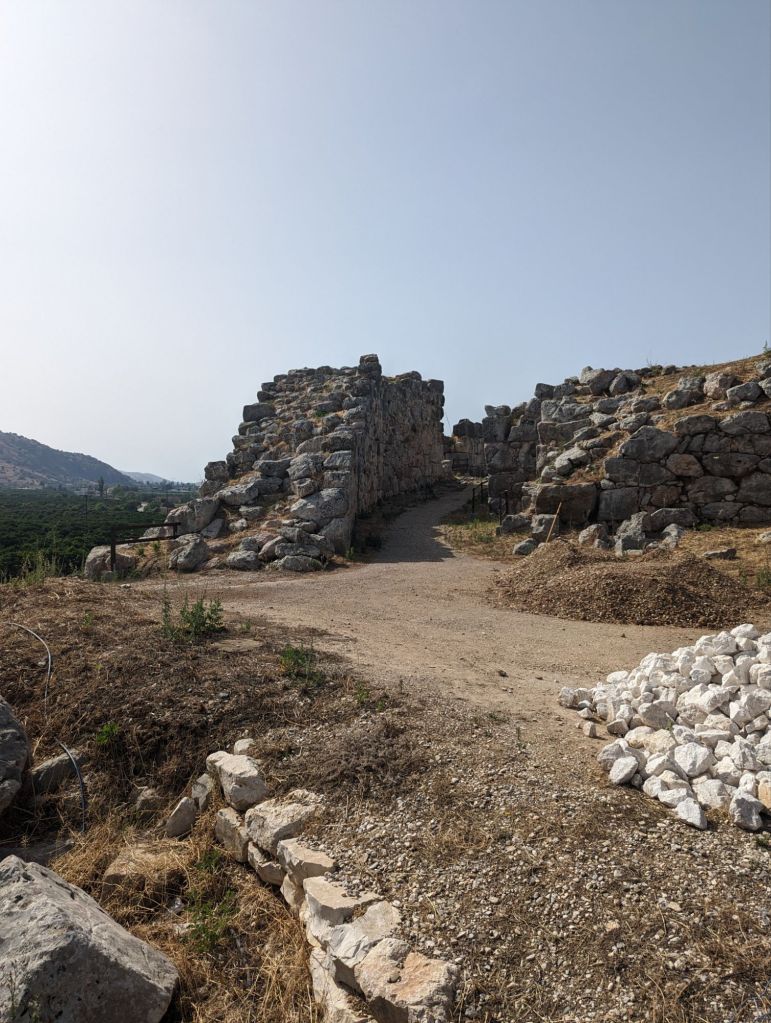
Our first stop was the Acropolis of Tiryns, a Bronze Age citadel. It was excavated by the German Institute of Archaeology since it was first discovered in 1831. It now looms over the plains on its shallow hill, its cyclopean walls visible to any passer-by. The Great Megaron, in the upper citadel portion, was still visibly defined by its foundations. The hearth, column pedestals, and where the throne once stood are clearly marked out on the floor of the structure. Unfortunately, for our visit today, the main entrance of the citadel was closed to the public, making it impossible to enter the fortification from how it would have been entered back in its glory days. We also did not see the stone blocks that were polished by the sheep that rubbed against them when they were herded several thousand years ago. Fortunately, we still had access to both the upper and lower citadel sections through smaller stairways that date back to the bronze age itself.
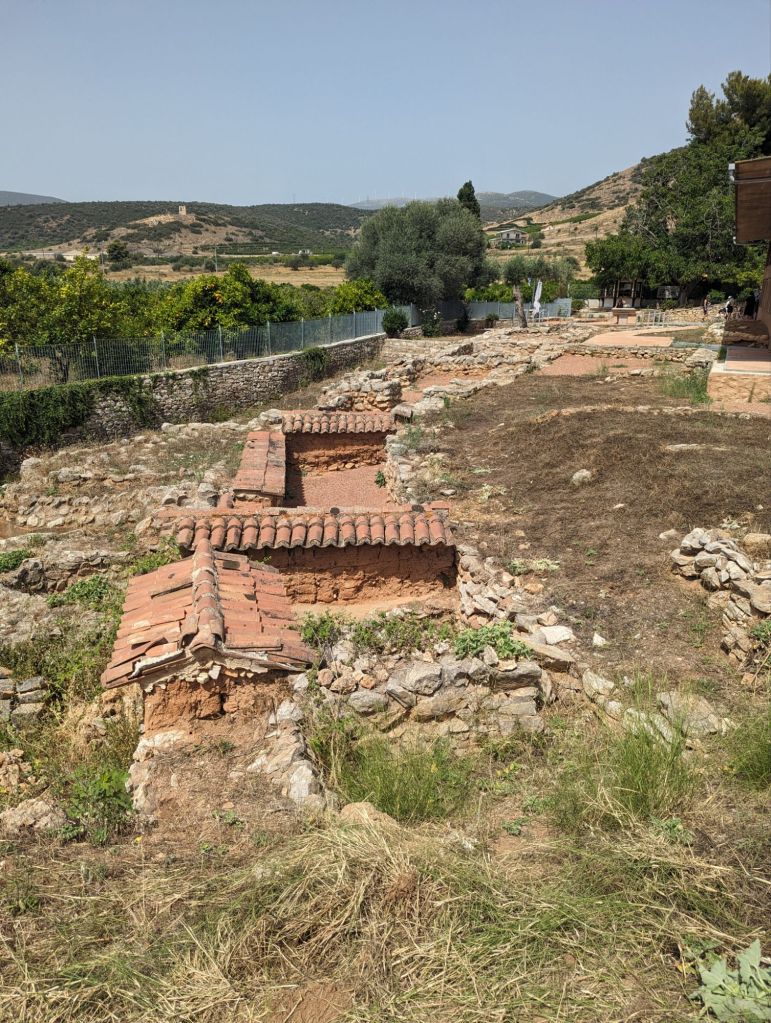
After this visit, we then headed off to the House of the Tiles in Lerna. The site was much bigger than I had previously anticipated as many secondary structures were found around the so-called palace. The House of the Tiles could be explored in comfort as a larger concrete structure was built around it to preserve the four-thousand-year-old mudbrick walls. The site was well organized allowing visitors to distinguish between each structure, from the palace, to the walls, to the storage areas, and the graves. Even the tumulus that used to cover the House and is the reason for its preservation, can still be seen today.
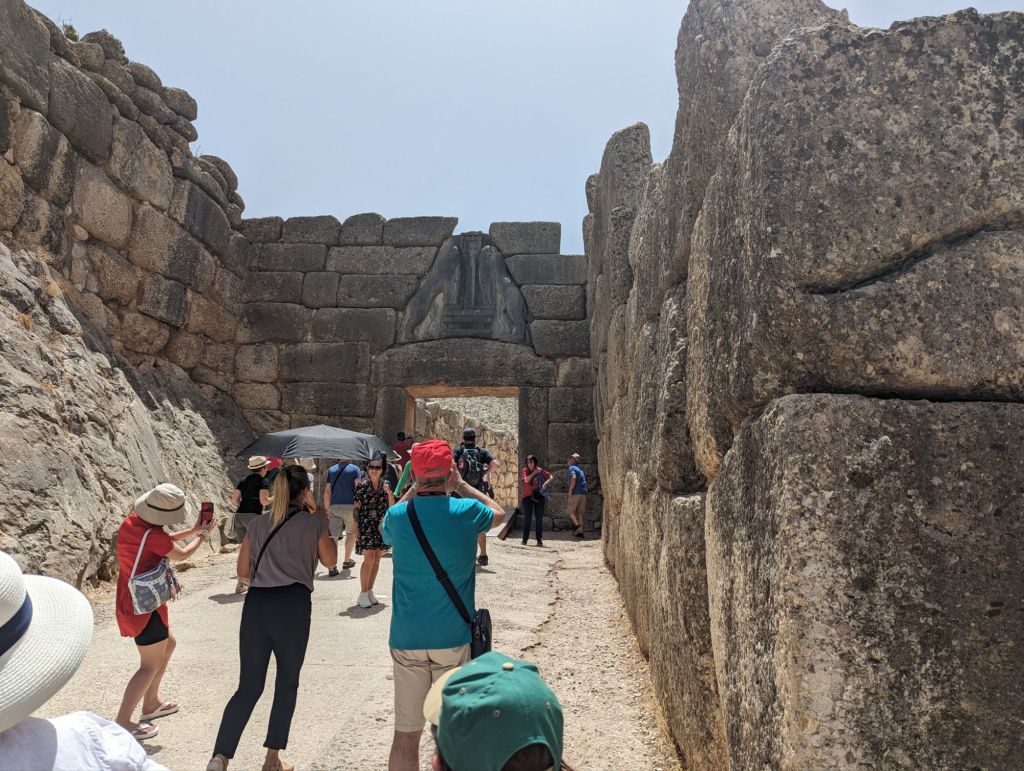
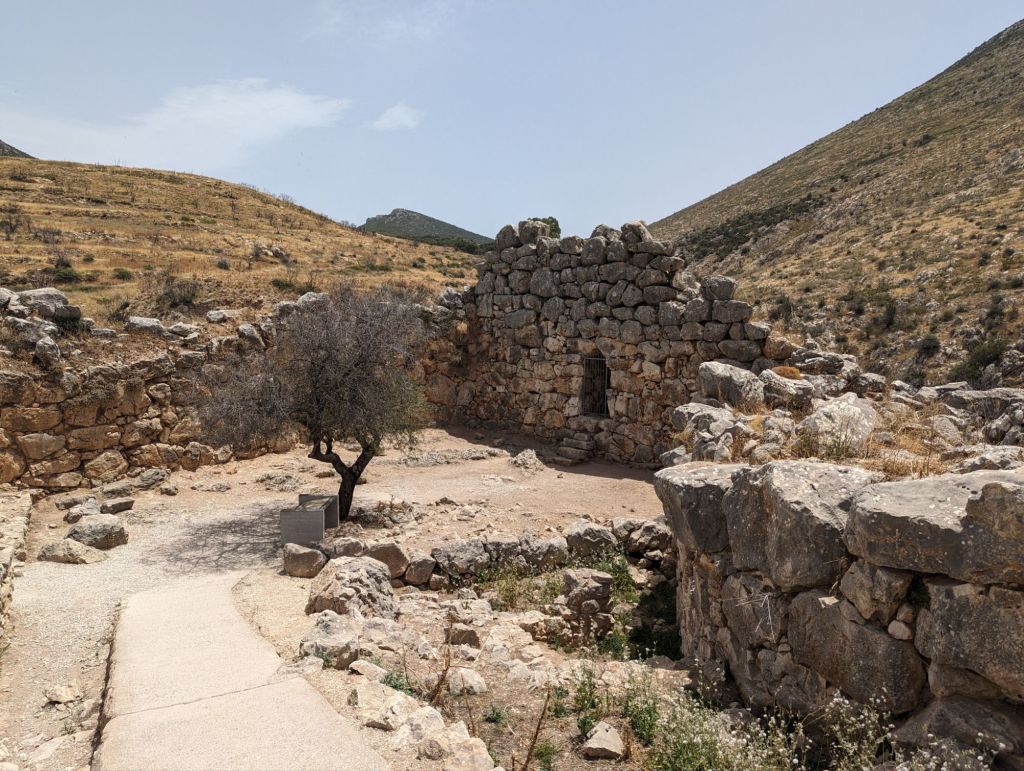
Our third stop was the Bronze Age citadel of Mycenae. Framed between two mountains, this elevated citadel dominates its landscape, offering wonderful views of the hills and plains that surround it. The sight of the fortification and its ornate gateway presented a more imposing sight than the citadel of Tiryns. And this is no empty comparison, as Mycenae, Tiryns, and Argos often quarreled and competed against one another over the Argive plains that divided them. It was even once believed that the Mycenaean rulers controlled Tiryns as a trading post, possibly due to the grander scale of their citadel. Though nothing much remains of the palace, there is still plenty to see. A particularly interesting find is the foundation of a Hellenistic temple, which was built over the remains of an Archaic temple, using the same plan as its predecessor. The presence of such a temple indicates that the Greeks of the later periods still took much pride in their Mycenaean lineage and built the temples to legitimize their claim to the land.
Shortly after our lunch, we drove down to the Treasury of Atreus, just a few minutes away. Similar to the grand scale of the citadel of Mycenae, this structure is visible from great distances. No photograph gives justice to the size of this tholos tomb. The stone blocks used to build it are massive, especially the lintle that hangs over the door, which weighs around 120 tons. Although it had been looted a long time ago, the Treasury of Atreus was a spectacle to visit all by itself.
Our final archaeological stop was Epidaurus and the sanctuary of Asclepius. Here we visited Greece’s most famous theater, one that is still in use today. Though we did not have the chance to see a live play, we still explored the vast Greek-styled seating area, orchestra, and the Roman stage. Afterward, we had the chance to see the temple dedicated to the healing god as well as other important buildings such as; the Catagogion which served as a hostel, the race track which was used in religious festivals, and the tholos which is a round colonnaded building. The museum was full of interesting Greek and Roman statuary, as well as pieces of Doric architecture.
Finally, after a full day of visiting excavated sites under the hot sun, we visited an orange orchard. The fruits we ate were the perfect refreshment to beat 40° weather! Overall, the experience was very enjoyable, and I am not one to say no to a glass of orange juice and a Greek cookie.
Of the Bronze Age sites that we visited today, especially the Mycenaean sites, the feature that really stood out to me was the large-scale fortifications. In the case of the citadels at Mycenae and Tiryns, the defensive structures were quite extensive, featuring multiple wall enclosures that we had the chance to visit. In the Late Helladic III Period they were expanded gradually. Initially with the uppermost defenses, usually centered around where the palace was to be located, and apexing with the extension of the fortified enclosure and the additions of cisterns and Sally ports. The cisterns and Sally ports are still visible at both citadels today. They would have been crucial to the survival of the defenders in the case of siege, but are also indicative of the unrest that is representative of the end of the Bronze Age. Another aspect of the fortifications is the changing thickness of the walls. Certain lengths of the walls were thin while those near the entrances were very thick. These meant that more defenders could be placed on them, ensuring that the weak points of the citadels were properly protected. These were also accompanied by bastions in certain areas, which were tower-like structures that jut out of the walls allowing an even heavier defensive presence. The bastions were especially noticeable when entering Mycenae’s Lion Gate, as they stood on both sides of it, creating a killing zone for any would-be invader. At the far earlier site in Lerna, they used mud bricks and stone blocks to build fortifications around the House of the Tiles. The mudbrick allowed the walls to be thick enough to accommodate more defenders similarly to the later citadels. The foundations for the stone bastions and the mudbrick walls were all still visible during our visit today. Though much smaller and far older, the site could be compared to the early stages of the Mycenaean citadels. This is perhaps why the large building in Lerna is considered a Palace by its custodians. Despite the significant fortifications in all three sites, they would all be destroyed at various points in history. Lerna, the oldest site, was burned, marking the end of the Late Helladic II period, before being buried under a tumulus that is still visible to this day. The other two were also burned during the Bronze Age Collapse despite their far more sophisticated fortifications. One can only wonder how these outcomes came about to these sites: Were they taken by surprise, severely outnumbered, or betrayed from within? Or was the siege a drawn-out affair, lasting many months? Argos destroyed Mycenae in 468 BCE, but what happened to its great citadel during the Bronze Age collapse? In any case, Lerna, Tiryns and Mycenae were all occupied even after their destruction and their legacies can still be admired today.

 Concordia CMLL Study Tour
Leave a comment